Research procedure
Calculate efficiency using task-time benchmarks
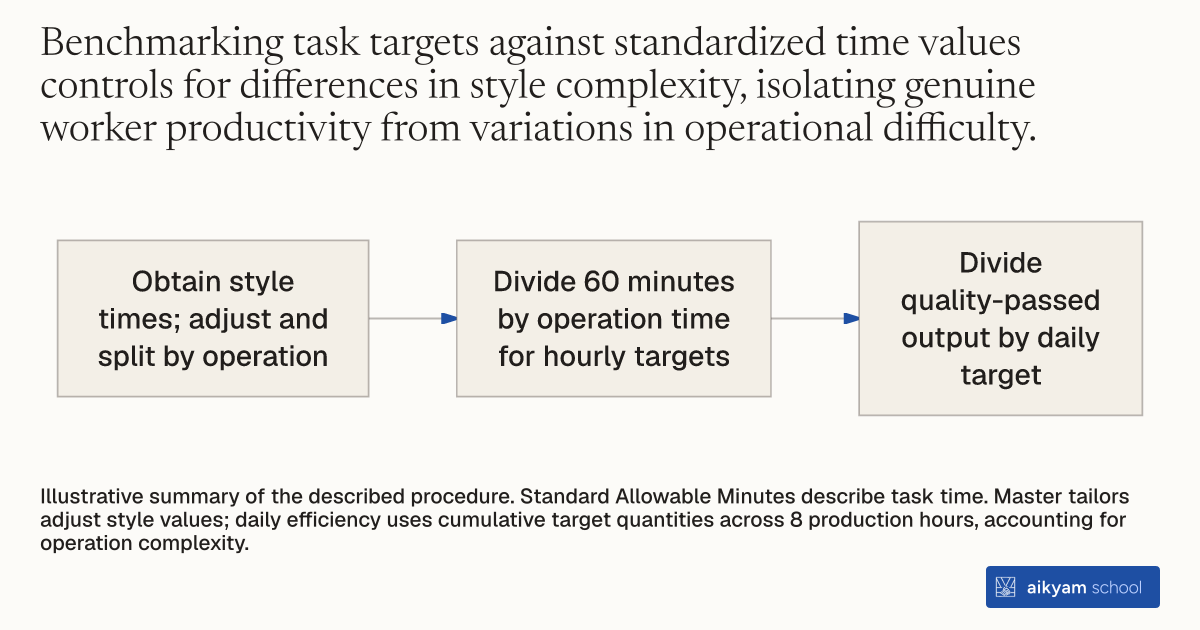
- Obtain style times; adjust and split by operation
- Divide 60 minutes by operation time for hourly targets
- Divide quality-passed output by daily target
Illustrative summary of the described procedure. Standard Allowable Minutes describe task time. Master tailors adjust style values; daily efficiency uses cumulative target quantities across 8 production hours, accounting for operation complexity.
See source →How
When to use
Measuring raw unit output in manufacturing environments without controlling for style or task difficulty obscures true worker efficiency when task complexity varies over time. Simple piece-rate counts penalize workers who are assigned to intricate assembly operations relative to those completing basic sewing tasks. Apply Standard Allowable Minute industrial engineering benchmarks to normalize operation complexity and establish accurate hourly target quantities for individual workers.
Calculate standardized worker production efficiency by benchmarking completed garment operations against global industrial engineering task complexity values.
- Obtain standardized Standard Allowable Minute baseline values from an international industrial engineering database for every garment style produced.
- Direct master tailors in the factory sampling department to adjust baseline style values for specific garment design variations.
- Decompose the total line-level style minutes into operation-specific increment values for each individual sewing machine operator on the assembly line.
- Calculate the hourly target production quantity for each worker by dividing sixty minutes by the assigned operation's specific minute benchmark.
- Record completed worker operations each hour that successfully pass inline quality inspection checkpoints.
- Compute daily worker efficiency by dividing total completed pieces by the cumulative target piece quantity across eight production hours.
Why it works
This prevents supervisors from misinterpreting reassignments to harder operations as drops in operator efficiency.
Example
Industrial engineers across five garment export factories in Bengaluru, India benchmarked daily task complexity for 2,703 female sewing operators across 112 production lines. Operators had an average operation complexity of 0.565 Standard Allowable Minutes and a target of roughly 106 pieces per hour, allowing researchers to measure that soft skills training raised assigned task complexity by 0.0384 minutes while simultaneously increasing efficiency by 10.8 percentage points.
About the study
Participants
2,703 female garment workers across 112 production lines in 5 export garment factories in Bengaluru, India (290,763 daily worker observations).
Study Design
Two-stage randomized controlled trial using tablet production records linked to industrial engineering Standard Allowable Minute benchmarks to calculate daily worker efficiency (produced pieces divided by target pieces).
Results
Standard Allowable Minute benchmarking measured a control mean operation complexity of 0.565 minutes and control efficiency of 54.2 percent, detecting a 0.0384 minute increase in assigned task complexity (p < 0.05) and a 10.8 percentage point efficiency gain (p < 0.05) among trained workers.