Research procedure
Record quality-passed output on tablets
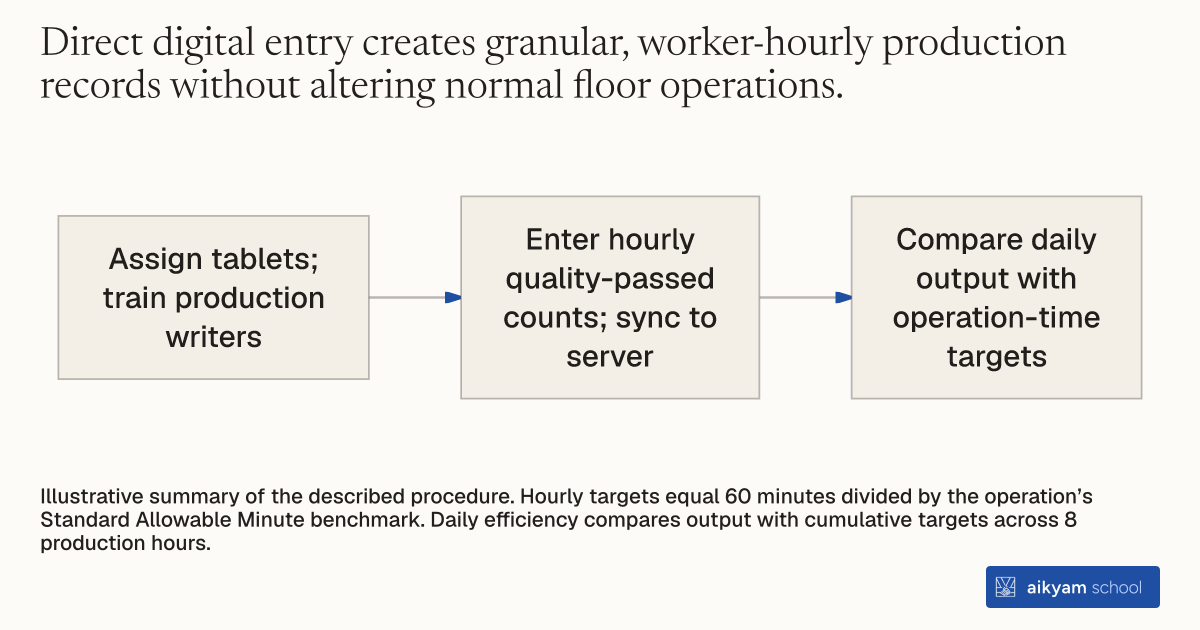
- Assign tablets; train production writers
- Enter hourly quality-passed counts; sync to server
- Compare daily output with operation-time targets
Illustrative summary of the described procedure. Hourly targets equal 60 minutes divided by the operation’s Standard Allowable Minute benchmark. Daily efficiency compares output with cumulative targets across 8 production hours.
See source →How
When to use
Factory production data collected on paper is frequently discarded after daily aggregation, preventing real-time monitoring of individual hourly output. Manual record-keeping also creates measurement error and limits feedback to supervisors during assembly line bottlenecks. Deploy tablet-based digital production tracking across factory floors to record real-time worker output and calculate daily operational efficiency.
Deploy touchscreen tablet computers to line production writers across sewing floors to digitize hourly worker output tracking and wirelessly sync performance data.
- Assign one tablet computer to each assembly line production writer on the factory floor.
- Train line production writers to replace paper record sheets by entering each machine operator's completed operations directly into the tablet each hour.
- Program tablet software to sync recorded hourly piece counts wirelessly to the central factory data server.
- Measure completed operations only after garments pass inline quality inspection checkpoints.
- Compute worker-level hourly targets by dividing sixty minutes by the industrial engineering Standard Allowable Minute benchmark for each operation.
- Calculate daily worker efficiency by dividing total pieces produced by the target piece quantity across eight production hours.
Why it works
Automated wireless syncing prevents manual transcription errors while providing standardized productivity metrics adjusted for operation complexity.
Example
Five garment export factories in Bengaluru, India equipped line production writers with tablet computers across 112 sewing lines. Writers recorded hourly production for 2,703 female garment workers, generating 290,763 daily efficiency records that enabled precise evaluation of worker productivity without disrupting factory routines.
About the study
Participants
2,703 female garment workers across 112 production lines in 5 export factories in Bengaluru, India (290,763 daily worker observations).
Study Design
Two-stage randomized controlled trial using tablet computers assigned to line production writers to record worker-hourly completed operations, linked with industrial engineering Standard Allowable Minute benchmark targets.
Results
Tablet tracking measured a control mean efficiency of 54.2 percent and average task complexity of 0.565 standard allowable minutes, detecting a 10.8 percentage point efficiency increase (p < 0.05) and a 0.0384 minute increase in assigned task complexity (p < 0.05) among trained workers post-treatment.