Research design
Assess learning at age 8
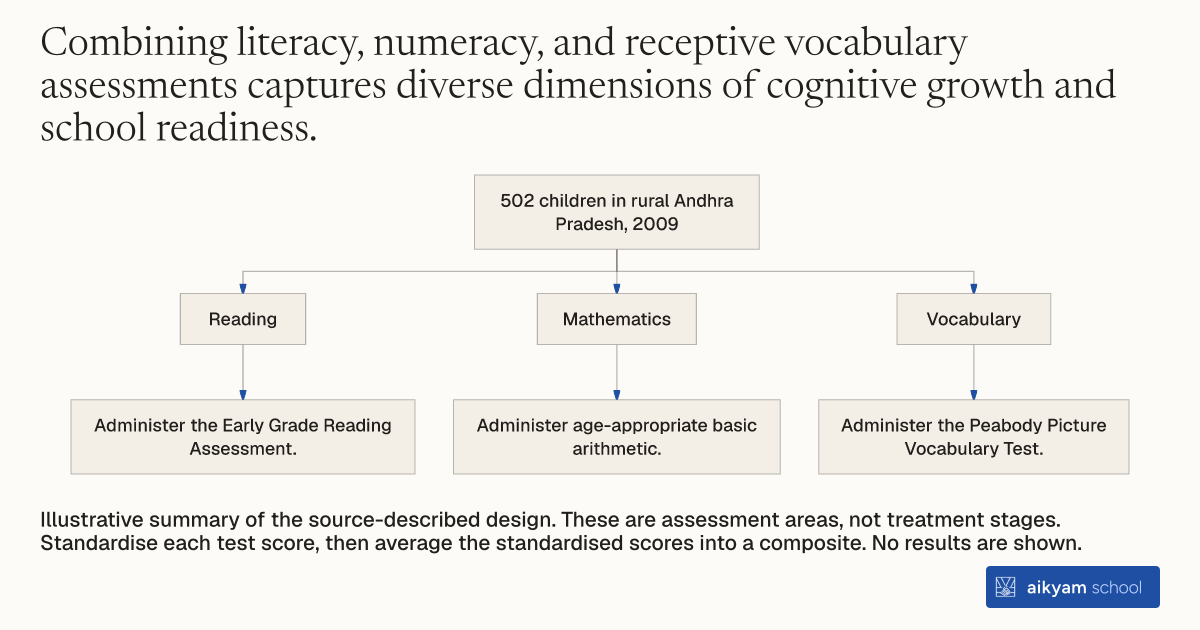
502 children in rural Andhra Pradesh, 2009
- Reading
- Administer the Early Grade Reading Assessment.
- Mathematics
- Administer age-appropriate basic arithmetic.
- Vocabulary
- Administer the Peabody Picture Vocabulary Test.
Illustrative summary of the source-described design. These are assessment areas, not treatment stages. Standardise each test score, then average the standardised scores into a composite. No results are shown.
See source →How
When to use
Evaluating long-term cognitive and learning gains from early childhood interventions requires objective measurements across multiple learning domains. Standardized cognitive and vocabulary assessments quantify foundational literacy, mathematical reasoning, and receptive vocabulary among primary school children. This method helps researchers measure human capital development in rural school-aged populations.
Administer a battery of standardized language, mathematics, and receptive vocabulary instruments to measure child learning skills at age 8.
- Administer the Early Grade Reading Assessment to evaluate letter recognition, word reading, sentence comprehension, and listening comprehension in the local language.
- Conduct a standardized mathematics test containing basic arithmetic computations tailored for 8-year-old primary school children.
- Administer the Peabody Picture Vocabulary Test to assess receptive vocabulary skills as a proxy for general cognitive ability.
- Calculate standardized z-scores for each test by subtracting the sample mean and dividing by the standard deviation.
- Compute an overall composite test score by taking the average of the individual standardized test z-scores to control for multiple hypothesis testing.
Why it works
Standardizing individual test scores into a single composite z-score reduces measurement error and prevents false positives from multiple inferences.
Example
In rural Andhra Pradesh, survey teams administered EGRA reading, math, and PPVT vocabulary tests to 502 eight-year-old children in 2009. Children born in village councils reserved for female leaders in 1995 scored 0.188 standard deviations higher on the composite test score compared to children exposed to female leadership only after age 5.
About the study
Participants
502 primary school children aged 8 years in late 2009 across 16 mandals in rural Andhra Pradesh, India.
Study Design
Cross-sectional testing battery administered during the third wave of the Young Lives Survey, analyzing normalized z-scores with mandal fixed effects and maternal controls.
Results
Early childhood exposure to female political reservation increased word recognition by 0.191 SD, reading fluency by 0.250 SD, listening comprehension by 0.248 SD, receptive vocabulary by 0.222 SD, and average composite test score by 0.188 SD.