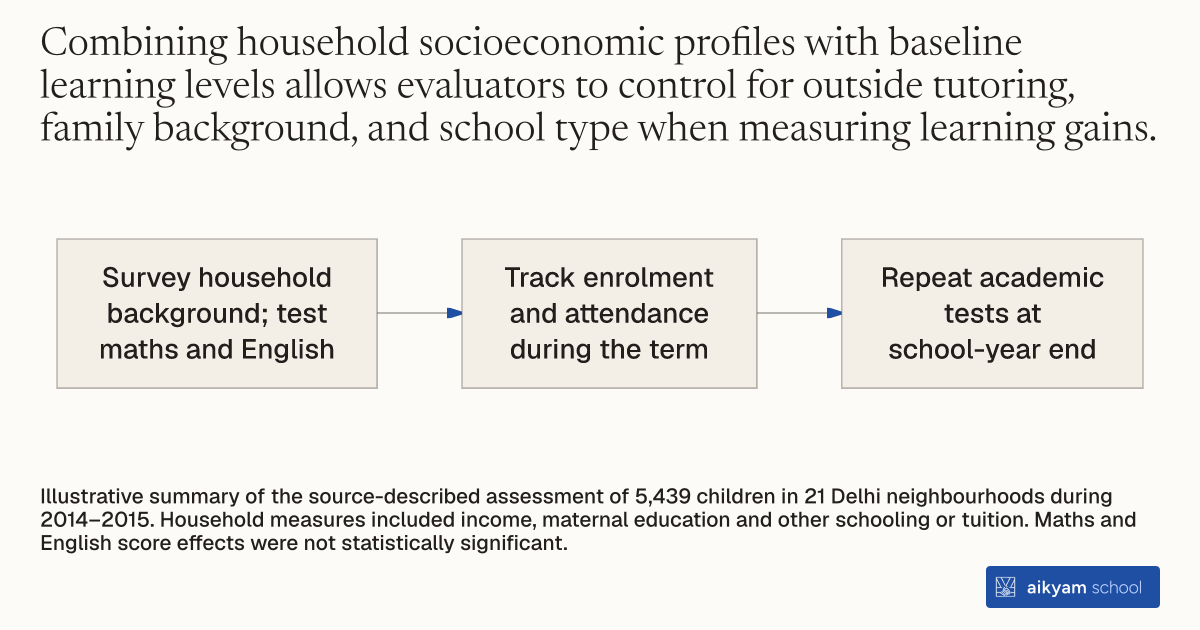
Research steps
Measure household background and learning
- Survey household background; test maths and English
- Track enrolment and attendance during the term
- Repeat academic tests at school-year end
Illustrative summary of the source-described assessment of 5,439 children in 21 Delhi neighbourhoods during 2014–2015. Household measures included income, maternal education and other schooling or tuition. Maths and English score effects were not statistically significant.
See source →How
When to use
Educational evaluations in low-income communities require baseline demographic and academic data to isolate program impacts. Without baseline household background and learning measurements, researchers cannot account for confounding family characteristics or alternative school choices. Conducting household surveys and baseline testing establishes a rigorous benchmark for evaluating program outcomes.
Collect household demographic data and evaluate student math and English skills before and after the program.
- Field surveyors visit target households in urban neighborhoods before program enrollment.
- Surveyors collect background data on household income, maternal education, and child enrollment in other tuition centers or private schools.
- Assessors administer baseline academic tests in math and English to participating students.
- Program staff track child enrollment and attendance across the academic term.
- Assessors re-test students at the end of the school year to measure changes in academic performance.
Example
Researchers surveyed households and tested 5,439 upper primary school children in math and English across 21 low-income Delhi neighborhoods during the 2014-2015 school year.
About the study
Participants
5,439 upper primary school children from 21 low-income neighborhoods in Delhi, India, where 10 percent attended private school and mothers averaged 3.7 years of education.
Study Design
Researchers conducted a randomized evaluation tracking attendance, household background, enrollment in tuition centers and other schools, and math and English test scores during the 2014-2015 school year.
Results
Mothers averaged 3.7 years of education, 10 percent of children attended private school, and tutoring attendance had no statistically significant impact on student test scores in math or English.