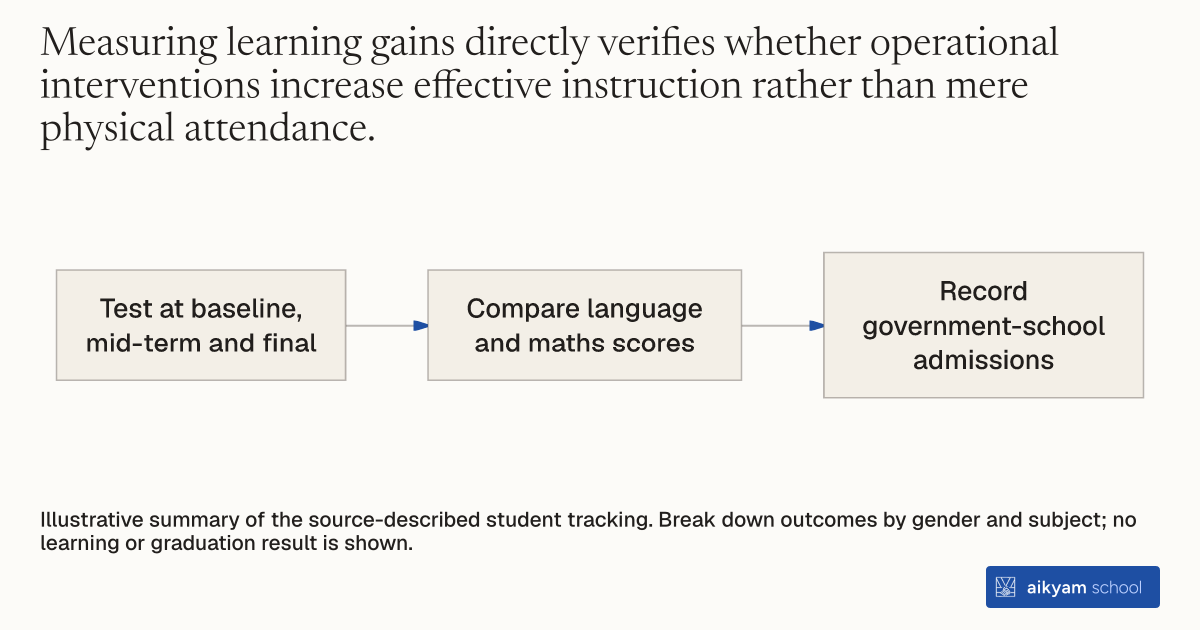
Research steps
Track learning and school progression
- Test at baseline, mid-term and final
- Compare language and maths scores
- Record government-school admissions
Illustrative summary of the source-described student tracking. Break down outcomes by gender and subject; no learning or graduation result is shown.
See source →How
When to use
Informal primary schools serving marginalized rural children often struggle to demonstrate educational effectiveness and long-term learning gains. Without systematic tracking of academic achievement and progression, programs cannot verify whether improved operational attendance translates into real student progress. Standardized learning and graduation outcome tracking measures educational impact over time.
Track educational impact by conducting standardized academic testing and monitoring student progression into formal government schools.
- Administer standardized baseline academic evaluations at the start of the school year.
- Conduct standardized mid-term and final examinations assessing basic language and math proficiency.
- Compare student performance gains between baseline, mid-point, and final evaluations across program classrooms.
- Record the proportion of students admitted into regular primary government schools upon graduation.
- Disaggregate outcome data by gender and subject area to evaluate specific learning improvements.
Why it works
Standardized tracking provides objective proof of academic quality to support graduation into formal public education.
Example
In rural Udaipur, India, Seva Mandir tracked student performance across informal single-teacher primary schools, demonstrating that camera-monitored teacher presence raised student test scores by 0.17 standard deviations and increased government school graduation by 62 percent.
About the study
Participants
Students in single-teacher informal schools in rural Udaipur, India, learning basic Hindi and math with about 20 students per school.
Study Design
Randomized controlled trial comparing academic achievement growth and government school transition rates between students in camera-incentive schools and control schools using standardized tests.
Results
Students in camera schools scored 0.17 standard deviations higher on tests, were 62 percent more likely to be admitted to regular government schools (35 percent treatment vs 24 percent control), and saw 7 percent more girls able to take a test that required writing.