Research steps
Compare stove performance
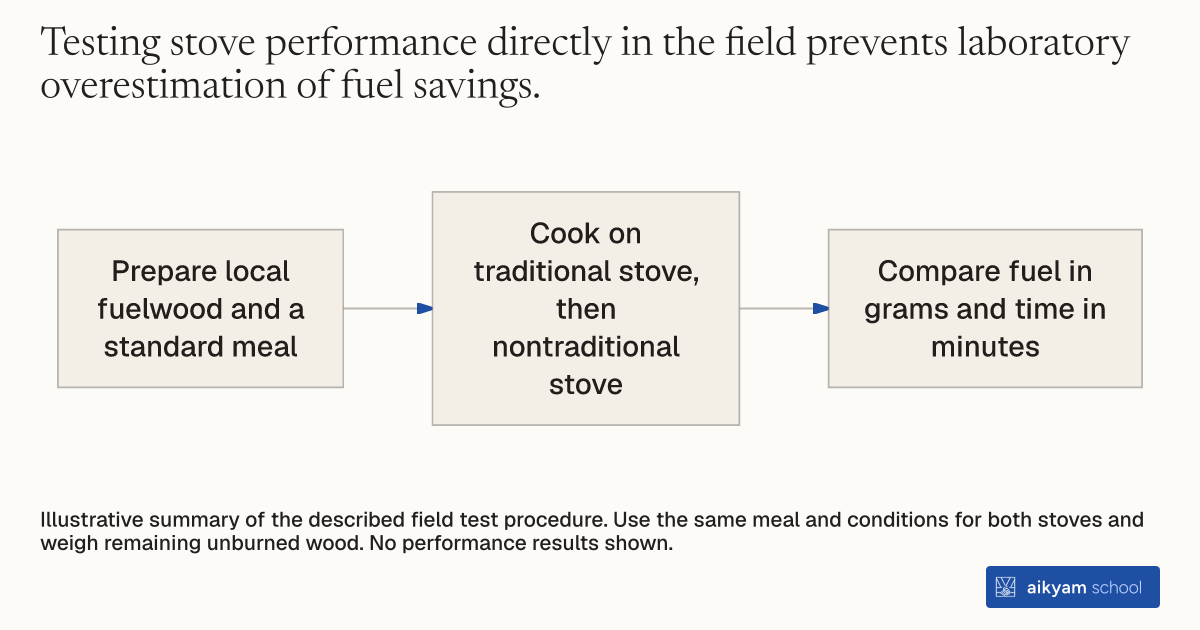
- Prepare local fuelwood and a standard meal
- Cook on traditional stove, then nontraditional stove
- Compare fuel in grams and time in minutes
Illustrative summary of the described field test procedure. Use the same meal and conditions for both stoves and weigh remaining unburned wood. No performance results shown.
See source →How
When to use
Researchers and engineers need to measure whether non-traditional cookstoves deliver real-world fuel savings compared to traditional designs. Laboratory performance tests often fail to reflect daily household cooking conditions, local fuel types, and meal sizes. Standardized field cooking trials measure fuel consumption and cooking duration under realistic household conditions.
Evaluate cookstove fuel efficiency and time performance under realistic household conditions using standardized local cooking tasks.
- Select representative local fuelwood species and prepare standardized food portions typical of target household meals.
- Direct field testers to prepare the standardized meal on a traditional clay cookstove, recording total fuelwood consumed in grams and total cooking duration in minutes.
- Repeat the exact meal preparation task using the non-traditional cookstove under identical field conditions.
- Weigh remaining unburned fuelwood and compare total fuel consumption and elapsed time between stove designs.
Why it works
Empirical comparison using local fuels and standard meal tasks isolates actual performance gains under realistic household usage.
Example
Researchers conducted standardized field cooking trials in rural Bangladesh to compare traditional clay cookstoves against non-traditional chimney cookstoves. Using local fuelwood and standard food quantities, the chimney stove consumed 950 g of fuelwood over 46 minutes, while the traditional stove consumed 900 g over 44.5 minutes.
About the study
Participants
Field cooking trials in rural Bangladesh using local fuelwood and standardized food quantities.
Study Design
Comparative empirical field cooking trials measuring fuelwood mass (in grams) and cooking time (in minutes) across traditional clay stoves and chimney stoves.
Results
Traditional cookstoves consumed 900 g of fuelwood and took 44.5 minutes, whereas chimney cookstoves consumed 950 g of fuelwood and took 46 minutes.