Research procedure
Build a clientelism index
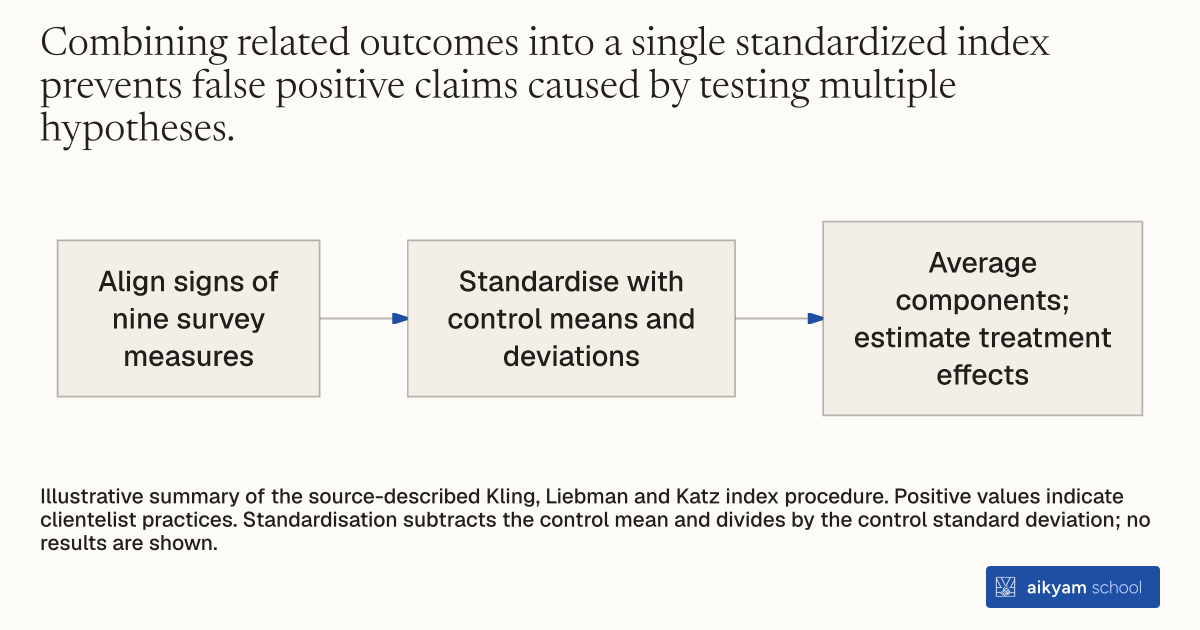
- Align signs of nine survey measures
- Standardise with control means and deviations
- Average components; estimate treatment effects
Illustrative summary of the source-described Kling, Liebman and Katz index procedure. Positive values indicate clientelist practices. Standardisation subtracts the control mean and divides by the control standard deviation; no results are shown.
See source →How
When to use
Evaluating complex political interventions involves measuring multiple distinct survey outcomes. Analyzing individual outcomes separately increases the risk of false positives through cherry-picked findings. Constructing a unified mean standardized index allows researchers to evaluate aggregate treatment impact across a family of related survey outcomes.
Construct a mean standardized outcome index using the Kling, Liebman, and Katz procedure to evaluate treatment impacts across related survey variables.
- Identify all survey questions capturing voter behaviors, attitudes, and perceptions related to political clientelism.
- Orient the sign of each variable so that positive values consistently indicate clientelist practices.
- Calculate the control group mean and standard deviation for each component outcome variable.
- Standardize each outcome variable by subtracting the control group mean and dividing by the control group standard deviation.
- Average the standardized variables across all component outcomes for each individual respondent or village cluster.
- Estimate treatment effects on the composite standardized index using ordinary least squares regression.
Why it works
A unified index aggregates small, consistent directional shifts across individual survey questions into a statistically robust summary measure.
Example
In Benin, researchers aggregated nine survey variables capturing political deliberation, campaign information, candidate knowledge, and gift receipt into a single clientelism index across 24 surveyed villages. In treated villages, the mean standardized clientelism index fell by 0.227 standard deviations relative to the control group.
About the study
Participants
1,920 adult survey respondents across 24 villages (12 treatment and 12 control) in 12 communes in Benin.
Study Design
Post-election household survey evaluating nine clientelism-related outcomes aggregated into a single index using the Kling, Liebman, and Katz standardization method.
Results
Treatment reduced the clientelism index by 0.227 standard deviations (p-value = 0.024), and by 0.223 standard deviations when excluding the vote-buying component (p-value = 0.049).