Research groups
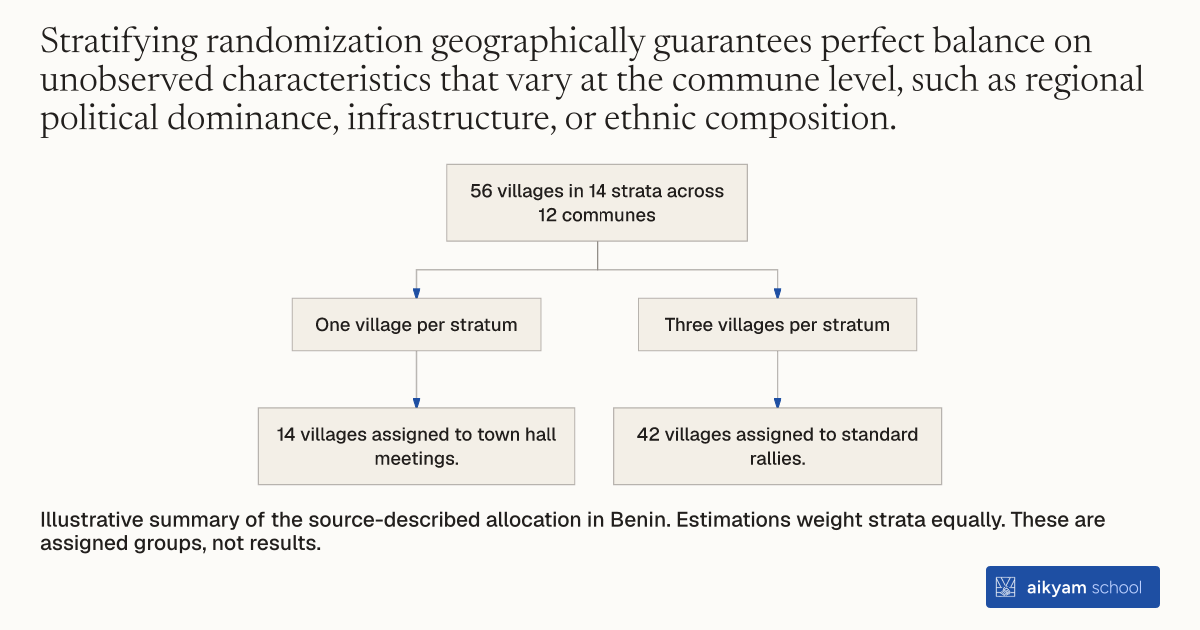
Randomise within geographic strata
56 villages in 14 strata across 12 communes
- One village per stratum
- 14 villages assigned to town hall meetings.
- Three villages per stratum
- 42 villages assigned to standard rallies.
Illustrative summary of the source-described allocation in Benin. Estimations weight strata equally. These are assigned groups, not results.
See source →How
When to use
Evaluating policy or campaign interventions across decentralized rural communities presents risks of geographic imbalance and regional bias. Randomizing villages within defined geographic administrative strata ensures structural comparability across treatment and control groups. Geographic stratified randomization balances commune-level unobservables while preserving spatial boundaries for experimental delivery.
Divide study communes into geographic strata and randomly assign treatment and control statuses to villages within each stratum.
- Select participating communes representing distinct electoral districts and candidate strongholds.
- Define geographic administrative strata within each participating commune.
- Randomly assign one village within each stratum to the experimental treatment group.
- Randomly assign the remaining three villages in the stratum to the control group.
- Weight statistical estimations equally across strata to ensure unbiased treatment effect estimates.
Why it works
It controls for geographic heterogeneity while generating valid counterfactual control units within the same local contexts.
Example
In Benin, researchers selected 12 communes containing 56 total study villages divided into 14 geographic strata. Within each stratum, one village was randomly assigned to deliberative town hall meetings (14 treatment villages) and three villages were assigned to standard campaign rallies (42 control villages).
About the study
Participants
56 villages (14 treatment, 42 control) across 14 strata in 12 communes, representing an average of 1,245 registered voters per village.
Study Design
Geographically stratified randomized controlled trial (1:3 treatment-to-control ratio per stratum) evaluated via weighted OLS regressions with stratum fixed effects.
Results
Geographic stratification yielded baseline covariate balance across treatment and control groups, with no statistically significant differences in age, gender, ethnicity, or schooling at the 5 percent level.