Try, learn and adjust
Check complete CV packets reach employers together
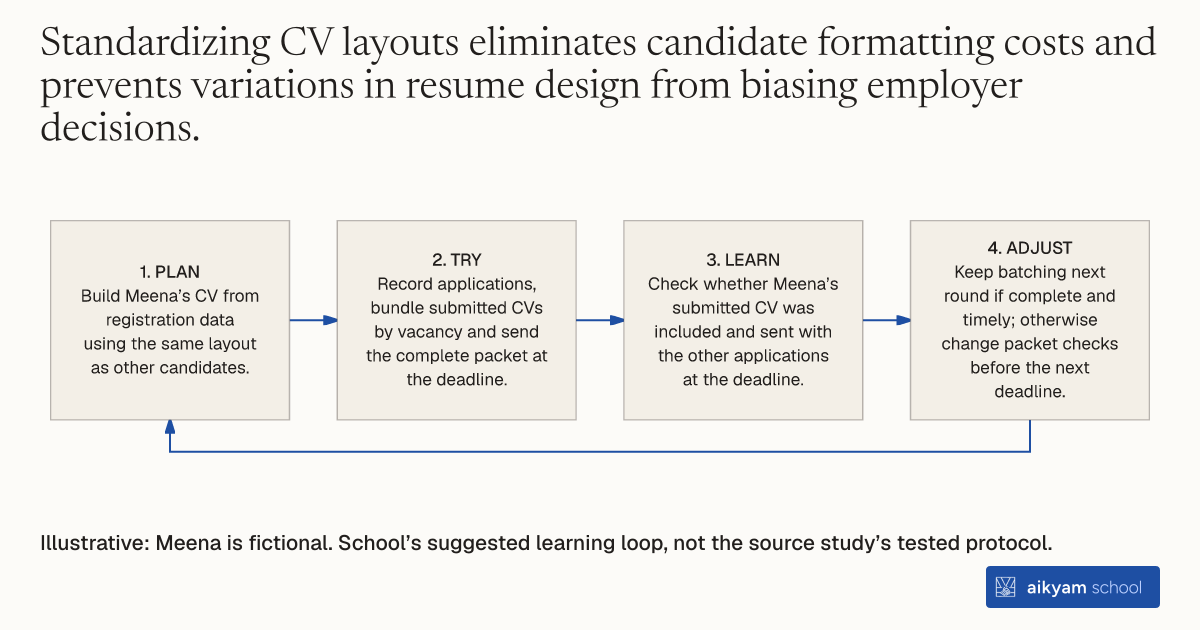
- Plan: Build Meena’s CV from registration data using the same layout as other candidates.
- Try: Record applications, bundle submitted CVs by vacancy and send the complete packet at the deadline.
- Learn: Check whether Meena’s submitted CV was included and sent with the other applications at the deadline.
- Adjust: Keep batching next round if complete and timely; otherwise change packet checks before the next deadline.
Illustrative: Meena is fictional. School’s suggested learning loop, not the source study’s tested protocol.
See source →School’s suggested, untested learning loop. Observe template consistency, packet completeness and deadline delivery; no interview effect is assumed.
How
When to use
Jobseekers often face barriers when formatting resume materials, while employers spend time reviewing non-standardized CVs with varying levels of completeness. Standardized template CV packet submission generates uniform resumes from candidate registration profiles and compiles all candidate applications into a single batch delivered on the job posting deadline. It is intended for public employment exchanges and matching platforms serving diverse jobseekers.
Submit jobseeker applications using standardized, platform-generated template CVs delivered to employers in consolidated batches at application deadlines.
- Populate a standardized resume template using demographics, education, and work experience collected during candidate registration.
- Maintain identical CV layouts and formatting across all candidates to eliminate design variation.
- Record candidate application decisions made via helpline call center or automated outreach.
- Bundle all submitted template CVs for a specific job vacancy into a single application packet.
- Transmit the complete application packet to the employer simultaneously on the specified application deadline.
Why it works
Transmitting applications in a single deadline packet ensures that application submission timing does not impact candidate interview probabilities.
Example
On the Job Talash platform in Lahore, Pakistan, call center staff generated standardized template CVs for 9,838 jobseekers using intake survey data. All applications submitted during monthly matching rounds were compiled into batch packets and sent to employers on the application deadline, converting applications to interview invitations at a 6.3% rate in the control group and 5.9% in the treatment group.
About the study
Participants
N = 9,838 jobseekers (1,116,952 jobseeker-vacancy matches) across 1,343 vacancies in Lahore, Pakistan; jobseekers ranged from primary education to university degrees.
Study Design
Observational application material analysis within a randomized field experiment, holding application design and delivery timing constant across treatment and control groups.
Results
CV standardization held application content quality constant, showing near-zero treatment effects on candidate profile updating (+0.025 CV completion effect), while treatment-induced marginal applications yielded a 5.87% interview probability (p = 0.647 relative to 6.29% control rate).