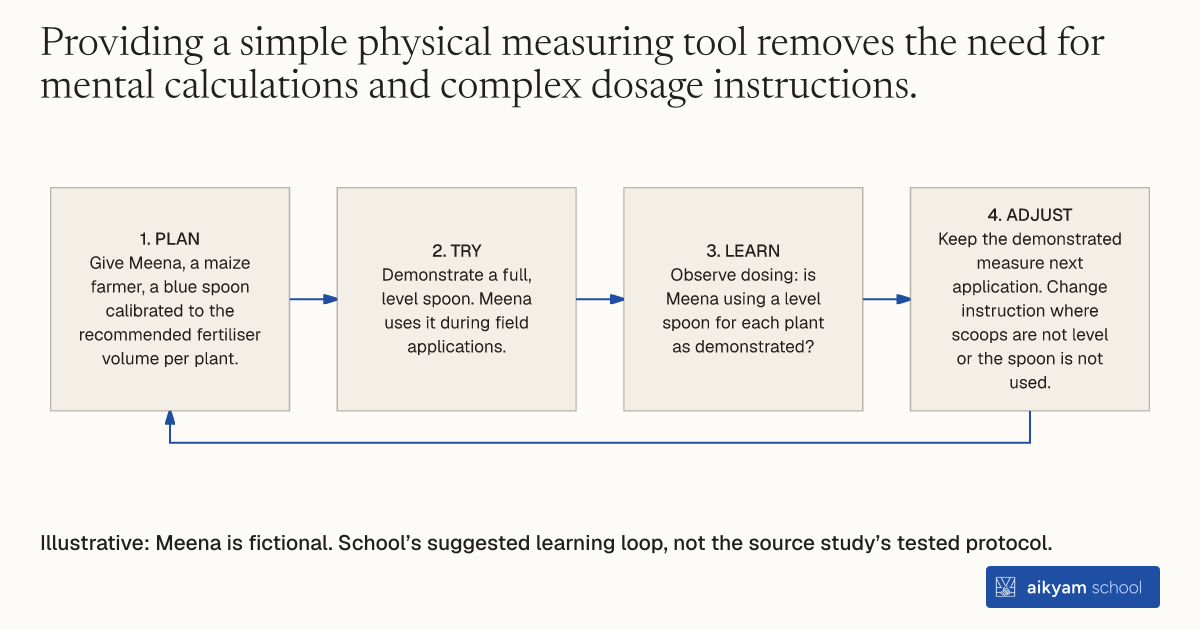
Try, learn and adjust
Check the measuring spoon is used as taught
- Plan: Give Meena, a maize farmer, a blue spoon calibrated to the recommended fertiliser volume per plant.
- Try: Demonstrate a full, level spoon. Meena uses it during field applications.
- Learn: Observe dosing: is Meena using a level spoon for each plant as demonstrated?
- Adjust: Keep the demonstrated measure next application. Change instruction where scoops are not level or the spoon is not used.
Illustrative: Meena is fictional. School’s suggested learning loop, not the source study’s tested protocol.
See source →School’s suggested, untested loop. Observe spoon use and knowledge of the recommended quantity. No spoon size or yield gain is added.
How
When to use
Smallholder farmers often struggle to apply the correct dosage of chemical fertilizer due to complex volume calculations. Incorrect fertilizer quantities can lower crop yields or waste expensive inputs. This method provides farmers with simple physical measuring tools to standardize fertilizer application rates on their fields.
Distribute pre-sized volumetric measuring spoons to farmers to standardize chemical fertilizer application quantities.
- Program officers procure simple blue kitchen spoons calibrated to the recommended volumetric fertilizer dosage per plant.
- Extension workers distribute the blue kitchen spoons to smallholder maize farmers during local agricultural advisory meetings.
- Extension trainers demonstrate how to scoop a full, level spoon of fertilizer for each crop plant.
- Maize farmers carry the measuring spoon to their fields during planting and top-dressing applications.
- Farmers use the spoon to apply the exact recommended quantity of fertilizer to every maize plant.
Why it works
Visual and tactile measurement aids make proper input dosing easy to execute repeatedly in real field conditions.
Example
In Western Kenya, researchers provided small-scale maize farmers with a simple blue kitchen spoon to measure fertilizer application amounts. Farmers who owned the blue spoon increased their knowledge of the recommended fertilizer quantity by 108 percent, an effect that persisted over time.
About the study
Participants
Small-scale maize farmers in Western Kenya.
Study Design
Randomized controlled trial measuring knowledge retention and fertilizer application accuracy among maize farmers provided with blue measuring spoons versus a comparison group.
Results
Providing maize farmers with a simple blue kitchen spoon increased knowledge of the recommended fertilizer quantity by 108 percent among farmers who owned the spoon, an effect that persisted after the intervention.