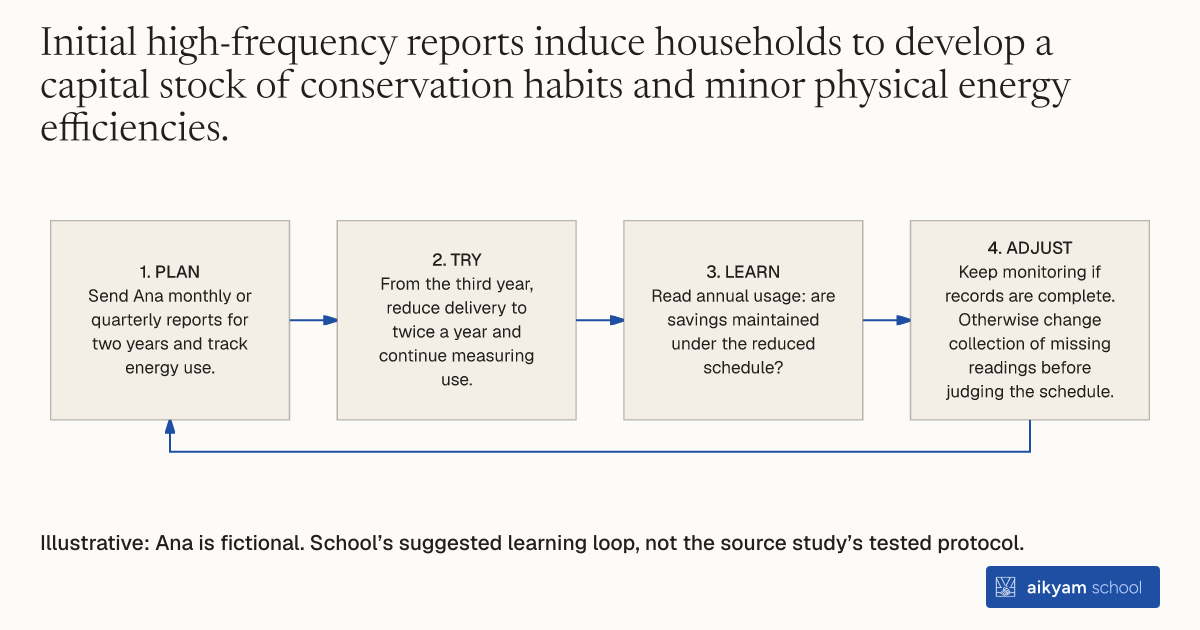
Try, learn and adjust
Check energy use after fewer reports
- Plan: Send Ana monthly or quarterly reports for two years and track energy use.
- Try: From the third year, reduce delivery to twice a year and continue measuring use.
- Learn: Read annual usage: are savings maintained under the reduced schedule?
- Adjust: Keep monitoring if records are complete. Otherwise change collection of missing readings before judging the schedule.
Illustrative: Ana is fictional. School’s suggested learning loop, not the source study’s tested protocol.
See source →School’s suggested learning loop: observe report frequency and annual energy use; this loop is separate from the tested schedule.
How
When to use
Utilities running behavioral conservation programs face high ongoing delivery costs when mailing monthly or quarterly home energy reports continuously over several years. Once consumers establish conservation habits and small efficiency capital, high-frequency reminders yield diminishing returns relative to their cost. Reducing report frequency after an initial habit-formation period maintains energy savings while significantly improving program cost-effectiveness for program implementers.
Reduce the mailing frequency of home energy reports after an initial period of high-frequency treatment once habituation and capital stock formation occur.
- Initiate home energy report delivery to target households at a high monthly or quarterly frequency for two years.
- Monitor household energy savings and track the attenuation of high-frequency action-and-backsliding cycles.
- Step down report delivery from monthly or quarterly mailings to biannual mailings starting in the third year of intervention.
- Maintain the reduced biannual mailing schedule indefinitely to reinforce established energy conservation habits and minor physical capital stock.
- Measure ongoing annual energy savings to confirm low post-intervention decay rates under the reduced schedule.
Why it works
Once this stock is formed, lower-frequency cues suffice to maintain habits and prevent backsliding without incurring full monthly mailing costs.
Example
In Site 1, Opower stepped down treatment for the continued group from monthly or quarterly reports to biannual reports at the beginning of 2012, achieving an incremental cost-effectiveness of 0.69 cents per kilowatt-hour.
About the study
Participants
72,154 single-family residential electricity customers in Site 1 in the Upper Midwest United States.
Study Design
Randomized control trial comparing households stepped down to biannual reports against discontinued households and control households over a four-to-five-year panel.
Results
Stepping down report frequency to biannual delivery generated substantial incremental energy savings at very low incremental cost, yielding an overall program cost-effectiveness of 1.21 cents per kilowatt-hour compared to 4.31 cents per kilowatt-hour for a one-shot intervention.