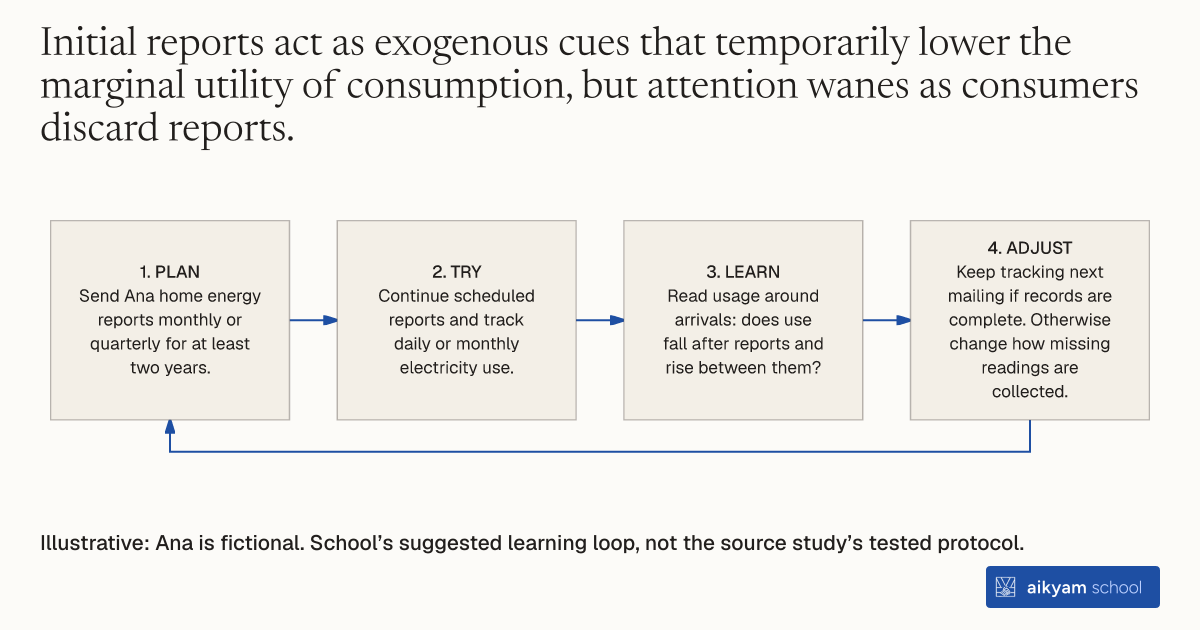
Try, learn and adjust
Check energy use between reports
- Plan: Send Ana home energy reports monthly or quarterly for at least two years.
- Try: Continue scheduled reports and track daily or monthly electricity use.
- Learn: Read usage around arrivals: does use fall after reports and rise between them?
- Adjust: Keep tracking next mailing if records are complete. Otherwise change how missing readings are collected.
Illustrative: Ana is fictional. School’s suggested learning loop, not the source study’s tested protocol.
See source →School’s suggested learning loop: observe report timing and electricity use; this loop is separate from the tested mailing schedule.
How
When to use
Single initial nudges or isolated information campaigns often produce transient behavior changes as consumers quickly backslide after attention fades. Utilities seeking sustained domestic electricity reductions require an ongoing delivery mechanism to maintain salience. Mailing home energy reports at high initial frequencies counteracts rapid decay and repeatedly cues energy-saving actions.
Deliver home energy reports at high monthly or quarterly frequencies to repeatedly cue conservation behaviors and prevent complete backsliding.
- Assign target residential households to receive home energy reports on a monthly or quarterly schedule.
- Generate and mail reports repeatedly every month or quarter for at least two consecutive years.
- Track daily or monthly household electricity consumption to evaluate immediate post-arrival action and subsequent decay between report arrivals.
- Continue repeating mailings to attenuate the immediate action-and-backsliding cycles as consumers establish conservation routines.
- Maintain recurring report delivery until consumers develop a permanent stock of energy-saving habits and physical efficiency capital.
Why it works
High-frequency repetition repeatedly reactivates the cue, counteracts short-run backsliding, and prompts ongoing rehearsal of energy-saving habits.
Example
Opower mailed monthly and quarterly reports to households in Site 2 in the Northwest United States. In the first four reports, consumers reduced consumption by 0.185 to 0.197 kWh per day immediately after report arrival, though effects decayed at a rate of 0.708 kWh per day per year between quarterly reports.
About the study
Participants
123,000 residential electricity customers across monthly, quarterly, and bimonthly treatment groups with smart meters in Site 2 in the Northwest United States.
Study Design
High-frequency randomized control trial measuring 225 million daily electricity consumption observations around predicted report arrival dates over multiple years.
Results
Initial report arrivals caused an immediate reduction of 0.185 to 0.197 kWh per day, but these immediate conservation effects attenuated by more than four-fifths after the first four reports as households habituated to repeated mailings.