Research follow-up
Track energy use after reports stop
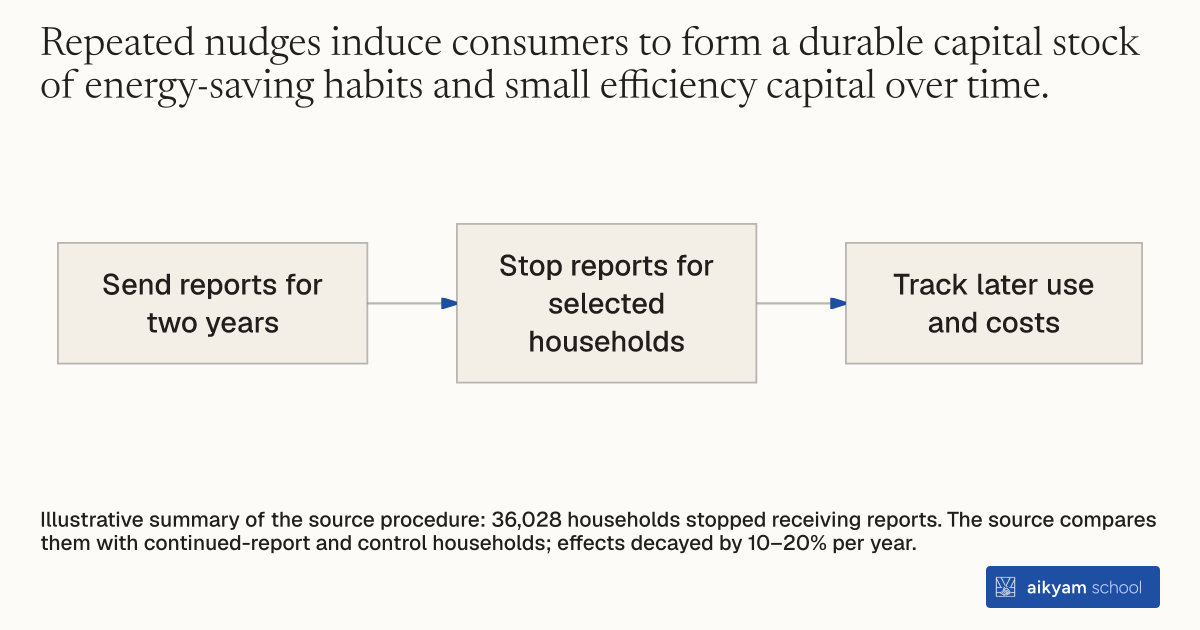
- Send reports for two years
- Stop reports for selected households
- Track later use and costs
Illustrative summary of the source procedure: 36,028 households stopped receiving reports. The source compares them with continued-report and control households; effects decayed by 10–20% per year.
See source →How
When to use
Program implementers running continuous nudge campaigns often assume that behavioral benefits vanish immediately once interventions stop. However, maintaining permanent delivery to all participants generates ongoing distribution and printing costs. Discontinuing nudges after an initial habit-formation period allows program managers to capture persistent long-run behavioral energy savings while freeing resources for new target populations.
Discontinue recurring nudge mailings after an initial treatment period to rely on post-intervention persistence for long-run behavioral savings.
- Deliver recurring home energy reports or behavioral nudges to targeted residential utility customers for two initial years.
- Monitor household participation and baseline energy savings during the initial two-year treatment period.
- Discontinue report mailings for a randomly selected subset or completed cohort of treated households after the initial period.
- Track ongoing post-intervention billing data to measure the annual decay rate of energy conservation behaviors.
- Account for persistent long-run energy reductions in program cost-effectiveness evaluations rather than assuming immediate zero-persistence drop-off.
Why it works
This accumulated capital stock depreciates slowly, maintaining significant energy conservation even when active nudges cease.
Example
Opower discontinued home energy reports after two years for 36,028 households across three utility sites in the Midwest and West Coast. In the post-drop period, these households maintained average electricity reductions of 0.584 to 0.627 kWh per day.
About the study
Participants
36,028 single-family residential electricity customers in the dropped group across three utility sites in the Midwest, Northwest, and Southwest United States.
Study Design
Randomized control trial comparing treatment households whose reports were discontinued after two years against continued treatment households and control households over four to five years.
Results
Post-intervention energy savings decayed at a slow rate of 0.10 to 0.20 kWh per day per year (10 to 20 percent annually), preserving more than double the lifetime energy savings expected under zero-persistence regulatory assumptions.