Research procedure
Model lifetime work and consumption
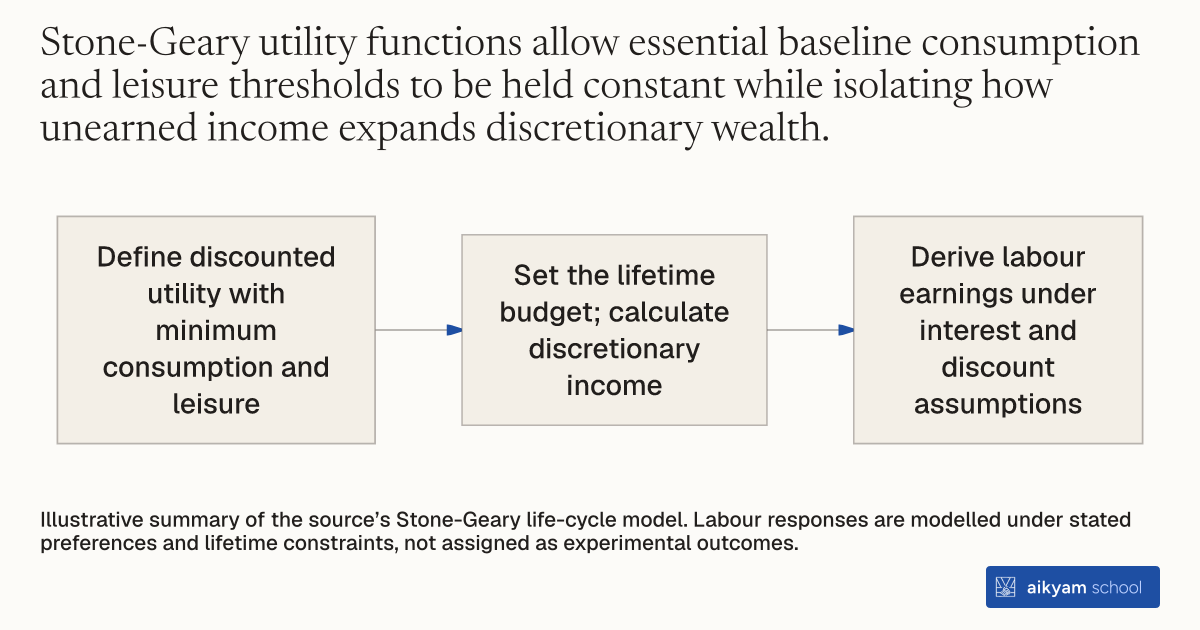
- Define discounted utility with minimum consumption and leisure
- Set the lifetime budget; calculate discretionary income
- Derive labour earnings under interest and discount assumptions
Illustrative summary of the source’s Stone-Geary life-cycle model. Labour responses are modelled under stated preferences and lifetime constraints, not assigned as experimental outcomes.
See source →How
When to use
Economists need to isolate how unearned wealth transfers alter labor supply over an individual's lifetime. Standard empirical models struggle to separate time-discounting preferences, interest rates, and remaining life span from raw labor reductions. Applying a Stone-Geary life-cycle utility framework provides structural parameters to model labor earnings choices under unearned income shocks.
Model individual utility over lifetime consumption and leisure choices using Stone-Geary preferences under an intertemporal budget constraint.
- Formulate a lifetime utility function summing discounted period utility over leisure minus minimum leisure requirements and consumption categories minus subsistence consumption thresholds.
- Define the intertemporal budget constraint where discounted lifetime wages, potential labor hours, and unearned income equal discounted lifetime consumption expenditures.
- Express lifetime discounted discretionary income as total potential labor earnings plus unearned income minus essential leisure and baseline expenditures.
- Derive the optimal period labor earnings equation as a function of wages, discount factors, interest rates, lifetime discretionary income, and yearly lottery prize payouts.
- Parameterize the proportion of yearly unearned prize payouts allocated to leisure reduction using interest and discount rate assumptions across remaining life spans.
Why it works
This structural formulation links empirical labor earnings reductions directly to lifetime utility parameters and annuity durations.
Example
Researchers modeled labor choices for 496 Massachusetts lottery players receiving 20-year annuity payments averaging 26,400 dollars per year. Applying the Stone-Geary life-cycle model under a 10 percent interest and discount rate across a 30-year post-winning lifespan yielded a predicted leisure consumption parameter close to the empirical 11 percent labor earnings reduction.
About the study
Participants
496 human lottery players (259 nonwinners and 237 winners; average age 50.2 years) in Massachusetts.
Study Design
Structural life-cycle utility optimization using Stone-Geary preferences evaluated against 13-year administrative Social Security Administration earnings panels and lottery prize data.
Results
The model estimates the marginal propensity to earn out of unearned income at approximately -0.11, with the duration-adjustment factor lambda calculated at 0.90 under 10 percent discount and interest rates.