Research steps
Build a stratified survey sample
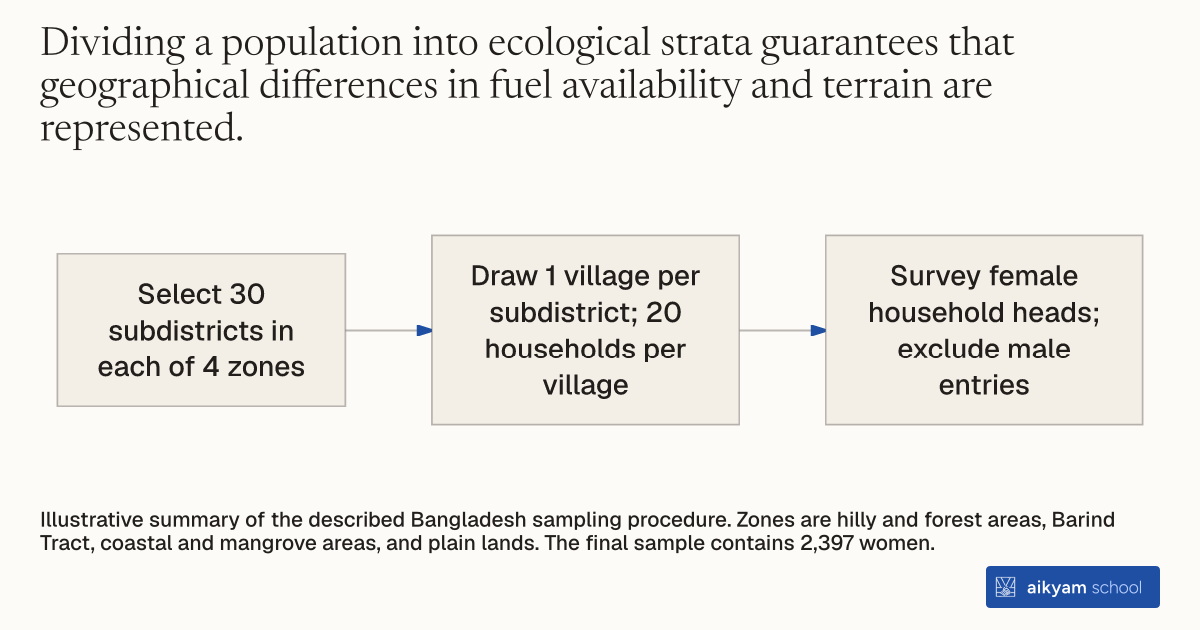
- Select 30 subdistricts in each of 4 zones
- Draw 1 village per subdistrict; 20 households per village
- Survey female household heads; exclude male entries
Illustrative summary of the described Bangladesh sampling procedure. Zones are hilly and forest areas, Barind Tract, coastal and mangrove areas, and plain lands. The final sample contains 2,397 women.
See source →How
When to use
Researchers need a nationally representative sample across diverse environmental terrains to study public preferences. Unstratified sampling risks missing ecological variation that influences local resource availability and household habits. Stratified sampling across ecological zones ensures balanced geographic coverage for population surveys.
Construct a representative national survey sample by stratifying geographic territories across distinct ecological zones.
- Divide the target country into four agro-ecological zones consisting of hilly and forest areas, Barind Tract, coastal and mangrove areas, and plain lands.
- Randomly select 30 subdistricts from each of the four agro-ecological zones.
- Randomly draw one village from each selected subdistrict to establish 120 survey villages.
- Randomly select 20 households from each drawn village.
- Administer the preference survey specifically to female household heads, discarding male respondent entries.
Why it works
Selecting subdistricts and villages randomly within each stratum prevents selection bias and yields statistically representative national insights.
Example
Researchers applied this method across rural Bangladesh in 2006 to build a representative sample across four agro-ecological zones. The process drew 20 households per village across 120 villages in 120 subdistricts, yielding a final analytical sample of 2,397 rural women.
About the study
Participants
2,397 rural women across 120 villages in Bangladesh.
Study Design
Four-stage stratified random sampling across four agro-ecological zones administered in 2006.
Results
Produced a nationally representative survey sample with zero male respondents, representing 98% to 99% biomass stove reliance.