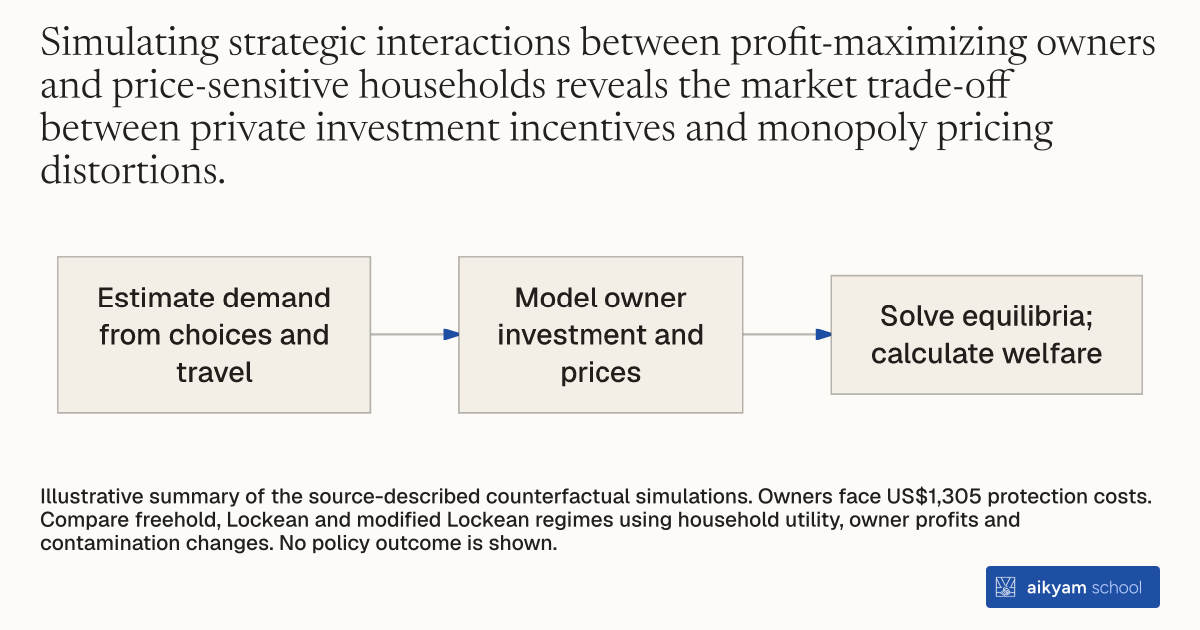
Research steps
Simulate alternative property regimes
- Estimate demand from choices and travel
- Model owner investment and prices
- Solve equilibria; calculate welfare
Illustrative summary of the source-described counterfactual simulations. Owners face US$1,305 protection costs. Compare freehold, Lockean and modified Lockean regimes using household utility, owner profits and contamination changes. No policy outcome is shown.
See source →How
When to use
Common property norms prevent landowners from charging user fees, restricting private water infrastructure investment. Conversely, private property rights introduce monopoly pricing that drives poor households to collect dirty water. Counterfactual structural simulations allow policy makers to evaluate economic welfare trade-offs under alternative property rights regimes before changing laws.
Simulate counterfactual social welfare across alternative property rights regimes by combining experimental demand parameters with owner profit-maximization models.
- Econometricians estimate household discrete choice demand parameters for water sources using revealed preference choices and walking times.
- Econometricians model private spring owners as profit-maximizing firms deciding whether to pay 1,305 US dollars to protect a spring.
- Econometricians model price-setting behavior among spring owners who compete non-cooperatively in localized spatial clusters.
- Econometricians solve for Nash equilibria in protection and pricing choices across alternative legal regimes, including freehold, Lockean, and modified Lockean property rights.
- Econometricians calculate net social welfare by combining household utility gains, landholder profits, and physical water contamination changes.
Why it works
Modeling alternative institutional rules identifies property rights regimes that induce infrastructure investment without driving poor families to contaminated alternative water sources.
Example
Researchers simulated counterfactual property regimes across 184 spring communities in western Kenya, finding that freehold private property reduced social welfare by 91 US dollars per spring relative to communal property because owners protected only 5 percent of springs while raising water collection travel times and increasing fecal contamination by 26 log points.
About the study
Participants
Counterfactual simulations across 184 viable spring communities in Busia and Butere-Mumias districts, Kenya.
Study Design
Game-theoretic Nash equilibrium structural simulations combining mixed logit revealed preference demand parameters, private profit-maximization models, and a 15-year spring lifespan discounted at 5 percent.
Results
Freehold property rights protected 5% of springs and reduced social welfare by $91 USD per spring; Lockean property rights protected 12% of springs with a $43 USD welfare loss; modified Lockean property rights protected 2% of springs with zero utility loss for households; and public vouchers protected 11% of springs while increasing social welfare by $124 USD per spring.