Try, learn and adjust
Check base pay, output pay and completion bonus
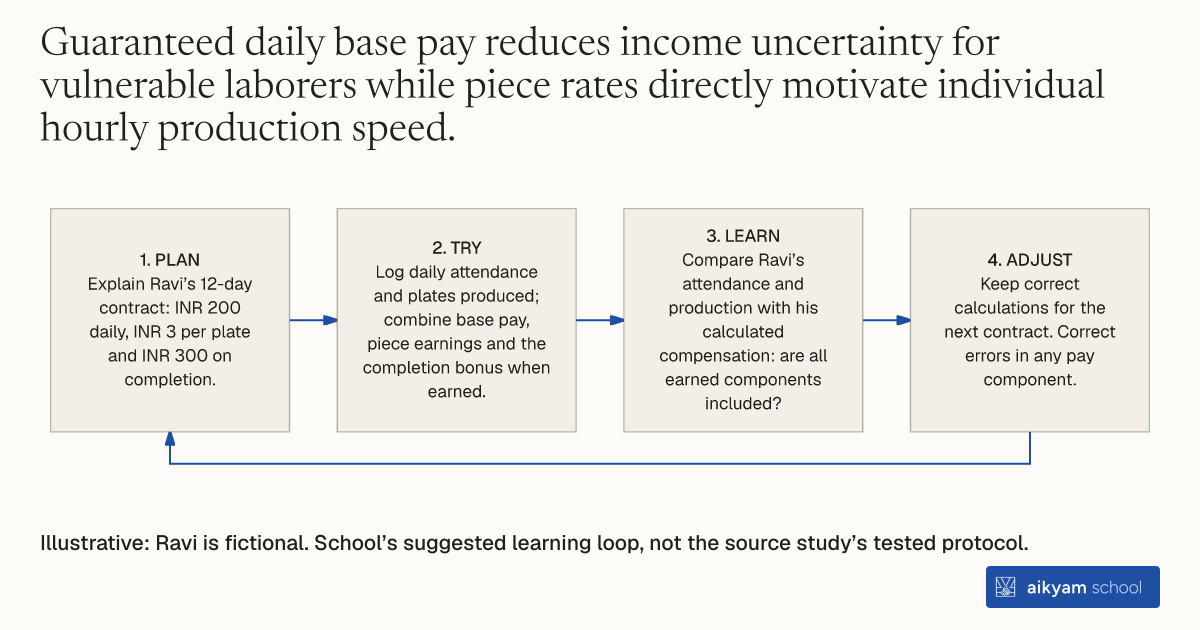
- Plan: Explain Ravi’s 12-day contract: INR 200 daily, INR 3 per plate and INR 300 on completion.
- Try: Log daily attendance and plates produced; combine base pay, piece earnings and the completion bonus when earned.
- Learn: Compare Ravi’s attendance and production with his calculated compensation: are all earned components included?
- Adjust: Keep correct calculations for the next contract. Correct errors in any pay component.
Illustrative: Ravi is fictional. School’s suggested learning loop, not the source study’s tested protocol.
See source →School’s suggested, untested loop. Observe attendance, production and earned compensation; pay terms alone do not establish productivity effects.
How
When to use
Short-term manufacturing contracts often struggle with worker attendance and variable output. Withholding all incentive pay until full contract completion leads to low daily motivation and high dropout rates. Structuring wages with a guaranteed daily base rate, piece-rate incentives, and a completion bonus secures steady workforce participation.
Structure temporary labor contracts using a three-part compensation model comprising base pay, piece rates, and a completion bonus.
- Establish a guaranteed daily base pay rate to cover baseline living expenses for attendance.
- Define a fixed piece-rate incentive paid for every individual unit of output produced.
- Set a lump-sum completion bonus awarded only upon finishing the full contract period.
- Log daily production volume and attendance for each worker at the worksite.
- Calculate total earned compensation by combining accrued base wages, piece-rate earnings, and the final bonus at contract end.
Why it works
The end-of-contract completion bonus encourages workers to maintain daily attendance across the entire work agreement.
Example
Researchers hired 408 workers in Odisha, India, for a 12-day leaf-plate manufacturing contract paying a base rate of INR 200 ($3.09) per day, INR 3 ($0.05) per plate produced, and an INR 300 ($4.63) completion bonus.
About the study
Participants
408 male manufacturing workers aged 18–55 across 47 villages in Odisha, India.
Study Design
Field experiment employing 408 workers under a structured compensation schedule during a 12-day leaf-plate manufacturing contract across five worksites.
Results
Workers received a base rate of INR 200 ($3.09) per day, INR 3 ($0.05) per plate produced, and an INR 300 ($4.63) completion bonus, establishing a baseline output before testing early payment liquidity interventions.