Try, learn and adjust
Check completion bonus eligibility
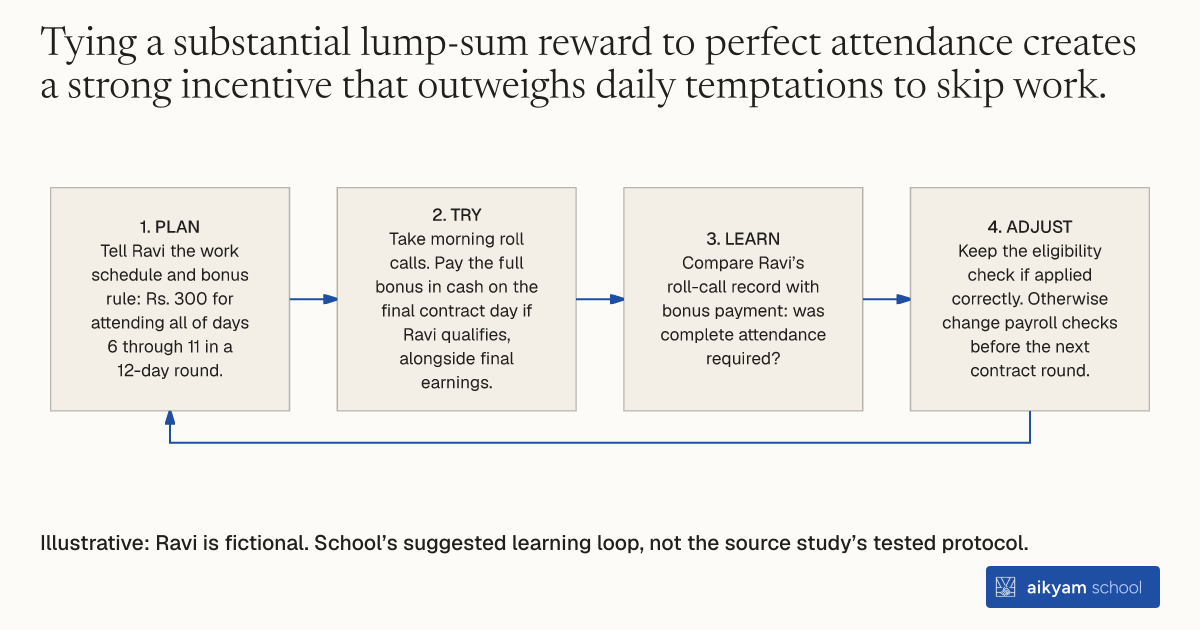
- Plan: Tell Ravi the work schedule and bonus rule: Rs. 300 for attending all of days 6 through 11 in a 12-day round.
- Try: Take morning roll calls. Pay the full bonus in cash on the final contract day if Ravi qualifies, alongside final earnings.
- Learn: Compare Ravi’s roll-call record with bonus payment: was complete attendance required?
- Adjust: Keep the eligibility check if applied correctly. Otherwise change payroll checks before the next contract round.
Illustrative: Ravi is fictional. School’s suggested learning loop, not the source study’s tested protocol.
See source →School’s suggested, untested loop: observe attendance on days 6 through 11 and final-day payment; no attendance gain is assumed.
How
When to use
Prevent worker absenteeism and contract attrition during temporary contract manufacturing projects. It solves the problem of selective attrition and work absences that disrupt production schedules or confound experimental evaluations. It serves operations managers, contractors, and field researchers employing casual wage laborers.
Structure a lump-sum completion bonus tied strictly to perfect attendance across the critical work period.
- Announce the full contract duration and daily schedule to casual laborers upon recruitment.
- Specify a lump-sum attendance bonus amount offered in addition to base wages and piece rates.
- Require complete attendance across all required workdays as a strict condition for receiving the bonus.
- Track daily attendance using morning roll calls at the worksite.
- Disburse the full completion bonus in cash on the final contract day alongside final earnings.
Why it works
High retention eliminates selective attrition, keeping labor supply fixed so employers and researchers can evaluate true worker productivity.
Example
At rural Indian manufacturing worksites employing 408 piece-rate workers across 14 contract rounds, managers offered an attendance bonus of Rs. 300 for completing all workdays from day 6 to day 11. Workers achieved a 98.3% daily attendance rate, and only 6 out of 408 enrolled workers dropped out before contract end.
About the study
Participants
408 male casual wage laborers aged 18 to 55 across 14 experimental rounds in rural Odisha, India.
Study Design
Implementation of an attendance completion bonus (Rs. 300 for attending days 6 to 11 in 12-day rounds; Rs. 200 in 6-day supplementary rounds) disbursed on the final contract day.
Results
Maintained a 98.3% daily attendance rate with zero difference between treatment and control groups (p=0.550), limiting overall contract attrition to 1.5% (6 dropouts out of 408 workers).