Research procedure
Develop and distribute flood-tolerant rice
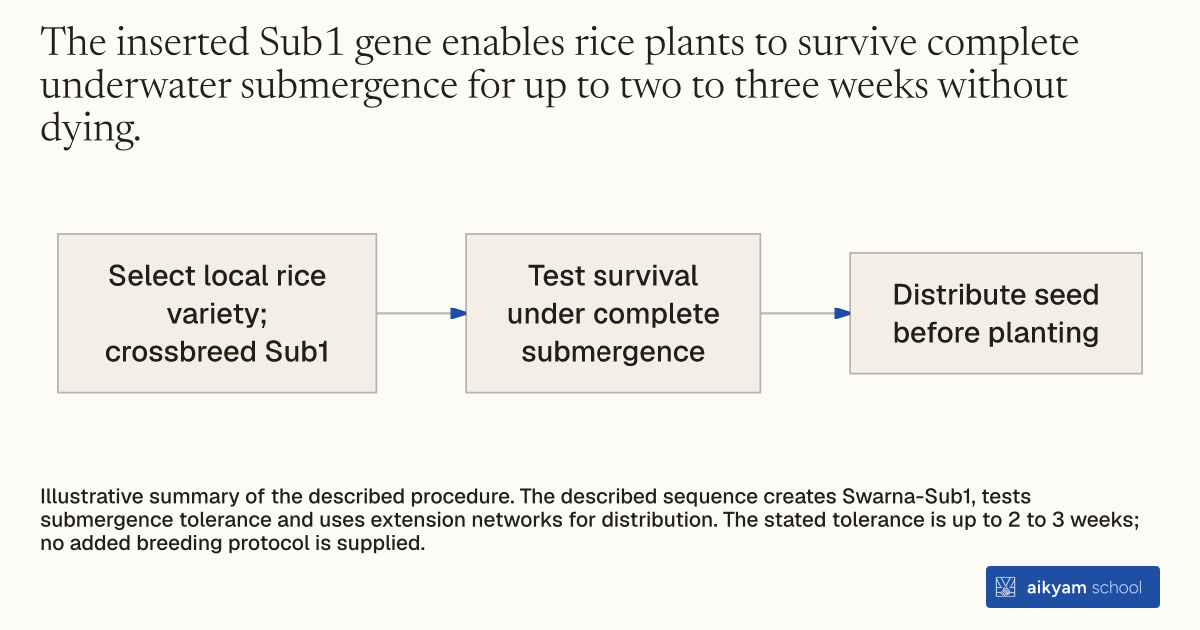
- Select local rice variety; crossbreed Sub1
- Test survival under complete submergence
- Distribute seed before planting
Illustrative summary of the described procedure. The described sequence creates Swarna-Sub1, tests submergence tolerance and uses extension networks for distribution. The stated tolerance is up to 2 to 3 weeks; no added breeding protocol is supplied.
See source →How
When to use
Extreme weather and severe river floods frequently destroy rice crops in flood-prone agricultural regions. Smallholder farmers face major financial risk and loss of income when fields remain submerged underwater. Crossbreeding stress-tolerant genes into popular seed varieties protects harvests from flood damage without lowering yields during normal years.
Crossbreed the flood-resistant Sub1 gene into popular local rice varieties to create stress-tolerant staple crops for smallholder farmers.
- Agricultural researchers identify high-yielding, widely cultivated rice varieties like Swarna.
- Plant geneticists insert the flood-resistant Sub1 gene into the recipient variety to create Swarna-Sub1.
- Lab and field teams test the crossbred variety to confirm survival during complete submergence.
- Extension networks distribute Sub1 seeds to smallholders in flood-prone areas before the planting season.
- Farmers sow and manage the stress-tolerant crop using standard local growing techniques.
Why it works
This genetic protection reduces crop loss risk while maintaining full yield potential during normal weather.
Example
Researchers from CGIAR and the International Rice Research Institute introduced Swarna-Sub1 to smallholders in Odisha, India. During the 2011 floods, planting Swarna-Sub1 increased rice yields by 64 kilograms per hectare for each additional day of submergence, providing a 628 kilogram per hectare yield advantage after ten days underwater.
About the study
Participants
128 flood-prone villages in Bhadrak and Balasore districts, Odisha, India; 1,280 smallholder farming households; 56 percent lived below the poverty line and owned an average of 0.84 hectares of land.
Study Design
Two-year randomized controlled trial comparing farmers across treatment and control villages over the 2011 flood season and 2012 non-flood season.
Results
Swarna-Sub1 increased yields by 64 kilograms per hectare per day of flooding between 7 and 14 days, prevented a 628 kilogram per hectare loss at 10 days of flooding (a 45 percent advantage), and showed no yield difference in non-flood conditions.