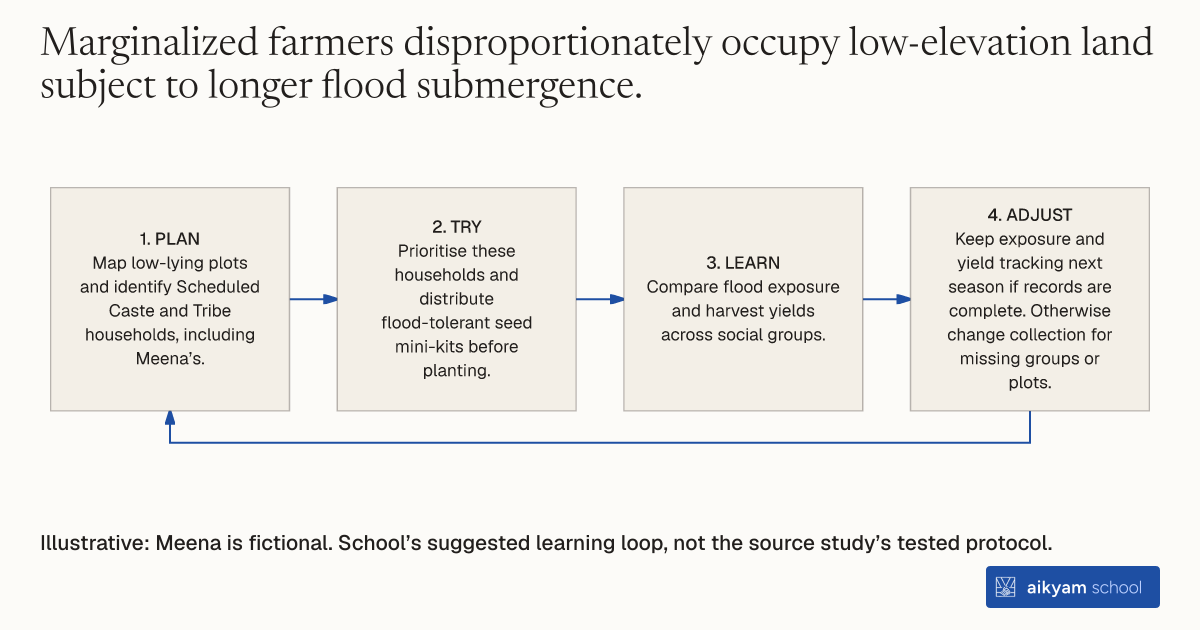
Try, learn and adjust
Check seed targeting against flood exposure
- Plan: Map low-lying plots and identify Scheduled Caste and Tribe households, including Meena’s.
- Try: Prioritise these households and distribute flood-tolerant seed mini-kits before planting.
- Learn: Compare flood exposure and harvest yields across social groups.
- Adjust: Keep exposure and yield tracking next season if records are complete. Otherwise change collection for missing groups or plots.
Illustrative: Meena is fictional. School’s suggested learning loop, not the source study’s tested protocol.
See source →School’s suggested learning loop: observe targeting, flooding and yields. The reported 40% versus 25% yield gains are simulated under universal adoption, not observed effects of this targeting loop.
How
When to use
Historically marginalized groups like Scheduled Castes and Tribes often farm low-lying, highly flood-prone land. Severe flooding disproportionately destroys their crops and deepens socioeconomic inequality. Targeting climate-resilient seed varieties to these vulnerable populations maximizes agricultural gains and promotes social equity.
Target stress-tolerant seed distribution to historically marginalized farmers who cultivate high-risk, low-lying land.
- Extension agencies analyze local topographical maps to identify low-lying, flood-prone agricultural plots.
- Field staff conduct household surveys to identify plots farmed by Scheduled Castes and Tribes.
- Agricultural coordinators prioritize marginalized households during pre-season seed allocation planning.
- Program staff distribute flood-tolerant seed mini-kits directly to targeted households before planting.
- Project evaluators track flood exposure and harvest yields across social groups to verify equity gains.
Why it works
Deploying stress-tolerant crops on these higher-risk plots produces larger yield improvements than on higher ground.
Example
Researchers analyzed flood exposure across 128 villages in Odisha, India, finding Scheduled Caste farmers experienced 1.83 more days of flooding in 2011 than higher-caste farmers. Simulation modeling demonstrated that planting Swarna-Sub1 increased rice yields by 40 percent for Scheduled Caste and Tribe farmers compared to 25 percent for higher-caste farmers.
About the study
Participants
128 flood-prone villages in Bhadrak and Balasore districts, Odisha, India; 1,280 smallholder households; 18 percent belonged to Scheduled Castes or Tribes, and 56 percent lived below the poverty line.
Study Design
Two-year randomized controlled trial combined with spatial flood exposure analysis and counterfactual simulation modeling of universal technology adoption.
Results
Scheduled Caste land faced higher peak flood probabilities (58 percent versus 43 percent for non-Scheduled Caste land), experienced 1.83 additional flood days in 2011, and achieved a simulated 40 percent yield increase under universal adoption compared to 25 percent for higher-caste farmers.