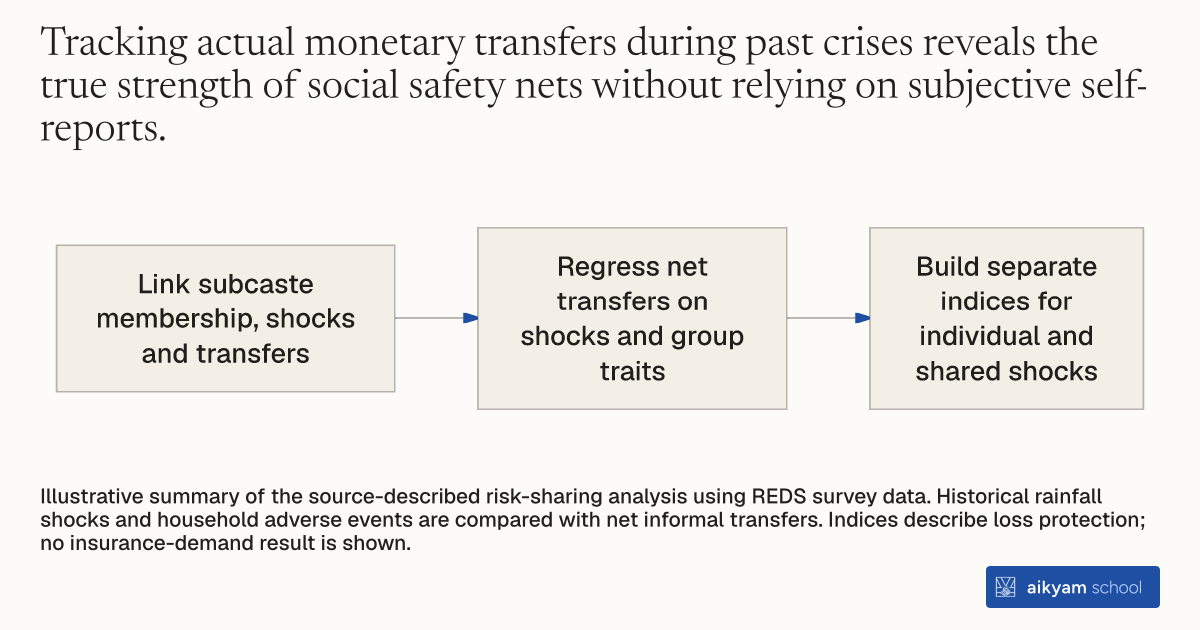
Research procedure
Measure informal protection against shocks
- Link subcaste membership, shocks and transfers
- Regress net transfers on shocks and group traits
- Build separate indices for individual and shared shocks
Illustrative summary of the source-described risk-sharing analysis using REDS survey data. Historical rainfall shocks and household adverse events are compared with net informal transfers. Indices describe loss protection; no insurance-demand result is shown.
See source →How
When to use
Program evaluators lack clear measures of how strongly traditional social networks protect households from individual financial shocks. Informal risk sharing varies widely across traditional subcastes, making standard village-wide wealth averages misleading. Constructing quantitative subcaste indices measures community capacity to absorb individual losses before introducing formal insurance.
Calculate quantitative subcaste risk-sharing indices using long-term survey data on interhousehold financial transfers and local shock realizations.
- Extract household listing data from nationwide rural panel surveys to identify subcaste network affiliations.
- Collect multi-year historical data on village-level rainfall shocks and household-specific adverse events.
- Record net informal financial transfers and emergency assistance payments received by households during difficulty.
- Regress household net transfers on village rainfall shocks and individual shocks interacted with average subcaste characteristics.
- Construct standardized indices ranking each subcaste by its ability to indemnify idiosyncratic losses and aggregate weather shocks.
Why it works
Distinguishing between individual and community-wide shocks shows whether a social network protects against personal emergencies or village-wide weather disasters.
Example
Researchers used national REDS survey listing data from 118,000 households to construct loss-indemnification indices for 118 subcastes across 63 Indian villages, identifying substantial variation in informal safety nets.
About the study
Participants
118,000 REDS census listing households across 118 unique subcastes in 63 rural Indian villages.
Study Design
Econometric regression modeling net interhousehold transfers against weather and individual shocks interacted with subcaste fixed effects.
Results
Subcaste risk-sharing indices successfully differentiated networks that indemnify idiosyncratic losses from those that pool aggregate shocks, explaining a 20 percentage point gap in index insurance demand.