Try, learn and adjust
Check assisted land-title registration
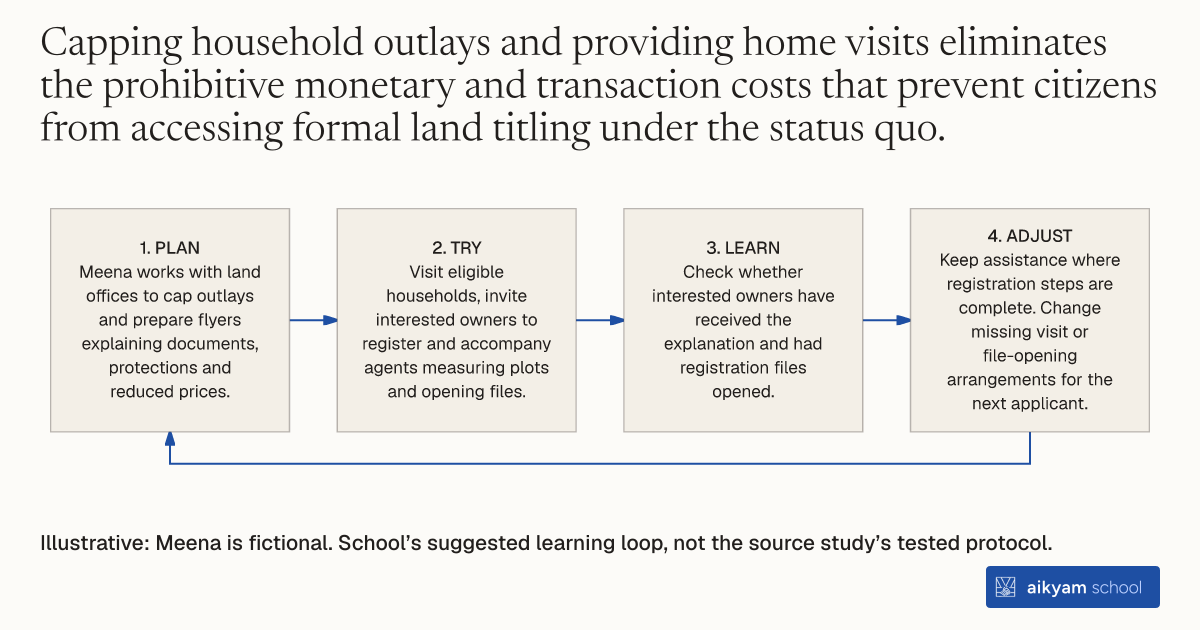
- Plan: Meena works with land offices to cap outlays and prepare flyers explaining documents, protections and reduced prices.
- Try: Visit eligible households, invite interested owners to register and accompany agents measuring plots and opening files.
- Learn: Check whether interested owners have received the explanation and had registration files opened.
- Adjust: Keep assistance where registration steps are complete. Change missing visit or file-opening arrangements for the next applicant.
Illustrative: Meena is fictional. School’s suggested learning loop, not the source study’s tested protocol.
See source →School’s suggested learning loop checks registration progress, separately from the tested subsidised offer.
How
When to use
In urban areas of developing countries, formal land registration rates are often extremely low due to high official fees and complex administrative bureaucracies. Property owners face prohibitive monetary and transaction costs that prevent them from securing legal titles under status quo procedures. Program managers deliver heavily subsidized land title offers and home-based registration visits directly to urban landholders.
Deliver heavily subsidized land titling offers directly to households through door-to-door visits and administrative assistance.
- Partner with provincial land titling and cadastral offices to cap title acquisition outlays at fixed subsidized prices as described in Section 4.1.
- Produce informational flyers detailing each formal document type, legal protection, and reduced promotional price as shown in Section 4.3.
- Visit eligible households at their compounds to explain the formalization opportunity and distribute informational flyers.
- Invite interested property owners to sign up for home visits by government land surveyors to initiate registration.
- Accompany cadastral and titling agents during compound visits to measure plots and open formal files as detailed in Section 4.4.
Example
Government officials and program staff conducted door-to-door visits across Kananga, DRC, offering eligible households subsidized titles capped at $100 compared to status quo costs up to $1,000.
About the study
Participants
4,343 randomly sampled households across 364 neighborhoods in Kananga, Democratic Republic of Congo, with 483 eligible households in the main analysis sample.
Study Design
Randomized controlled trial with household-level assignment to a door-to-door subsidized land titling offer versus status quo procedures.
Results
Program assignment caused a 44 percentage point increase in initiation of the land titling process and a 13.7 percentage point increase in actual receipt of formal land titles.