Try, learn and adjust
Check drought-triggered insurance delivery
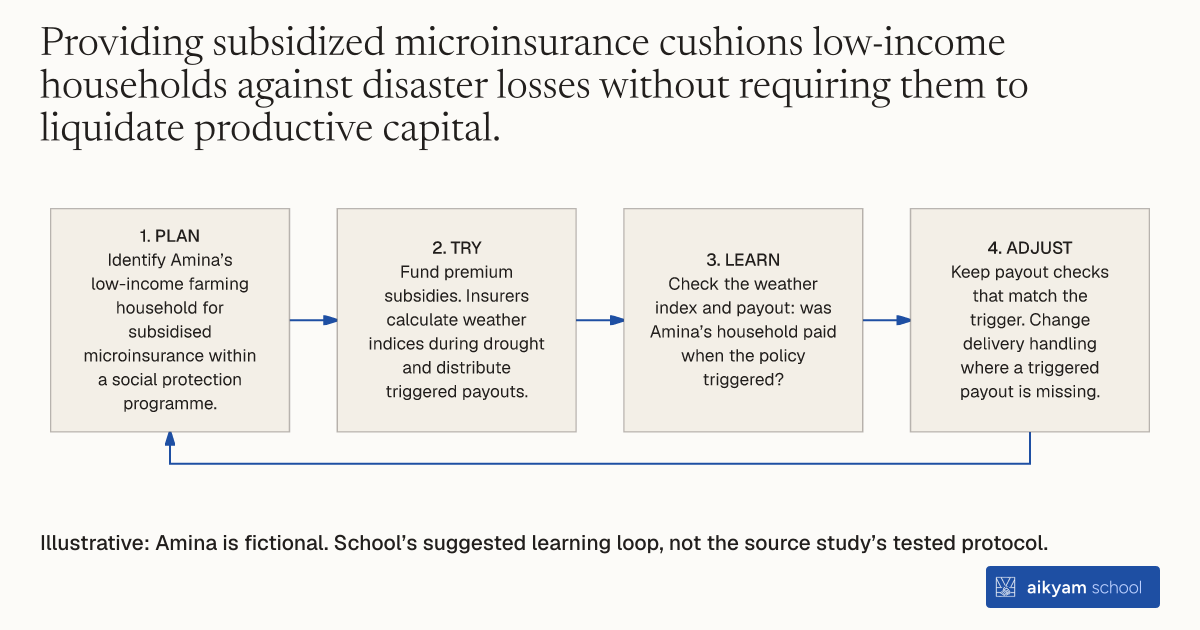
- Plan: Identify Amina’s low-income farming household for subsidised microinsurance within a social protection programme.
- Try: Fund premium subsidies. Insurers calculate weather indices during drought and distribute triggered payouts.
- Learn: Check the weather index and payout: was Amina’s household paid when the policy triggered?
- Adjust: Keep payout checks that match the trigger. Change delivery handling where a triggered payout is missing.
Illustrative: Amina is fictional. School’s suggested learning loop, not the source study’s tested protocol.
See source →School’s suggested, untested loop. Observe premium subsidies, weather triggers and payouts; this does not establish protection of food consumption or assets.
How
When to use
Smallholder farmers and pastoralists face catastrophic weather events like severe droughts that threaten household food security and assets. Uninsured households cope by selling off productive assets or reducing daily food consumption. Offering subsidized microinsurance as part of social protection programs protects assets and maintains household nutrition during severe climate shocks.
Offer subsidized microinsurance within government social protection programs to prevent asset liquidation and food insecurity following droughts.
- Social protection officials identify low-income agricultural households vulnerable to severe drought shocks.
- Program managers integrate subsidized microinsurance policies into public social protection frameworks.
- Government agencies fund insurance premium subsidies to eliminate financial barriers for poor farmers.
- Insurers calculate weather index metrics during extreme drought events.
- Insurers distribute microinsurance payouts to affected households to stabilize family income and prevent distress sales.
Why it works
It protects daily food consumption levels during post-disaster recovery periods.
Example
In Kenya, government agencies and researchers offered subsidized index microinsurance to smallholder farming households. Wealthier households receiving subsidized insurance avoided selling off productive assets to cope with drought shocks, while poorer households reported skipping fewer meals.