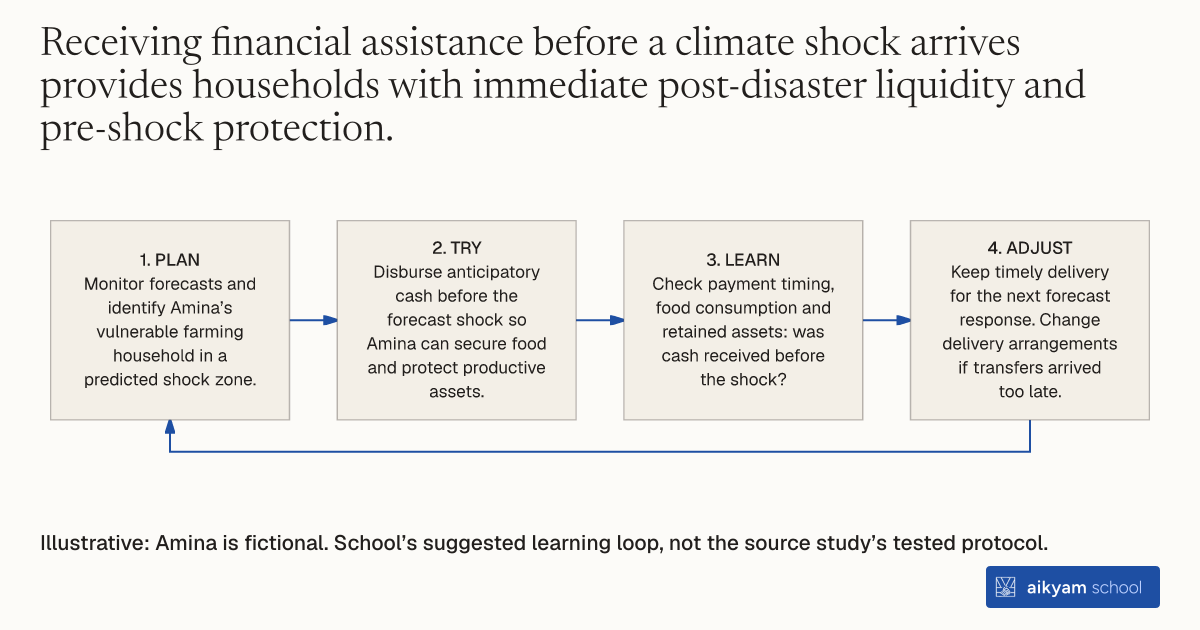
Try, learn and adjust
Check cash arrives before a forecast shock
- Plan: Monitor forecasts and identify Amina’s vulnerable farming household in a predicted shock zone.
- Try: Disburse anticipatory cash before the forecast shock so Amina can secure food and protect productive assets.
- Learn: Check payment timing, food consumption and retained assets: was cash received before the shock?
- Adjust: Keep timely delivery for the next forecast response. Change delivery arrangements if transfers arrived too late.
Illustrative: Amina is fictional. School’s suggested learning loop, not the source study’s tested protocol.
See source →School’s suggested, untested loop. Observe forecast timing, cash receipt, consumption and productive assets; do not infer causal protection from this check.
How
When to use
Weather shocks cause sudden financial losses that force rural families to cut food intake or liquidate assets. Distributing financial transfers prior to forecasted disaster events protects household consumption before damage occurs. It targets smallholder farming households operating in disaster-prone agricultural regions.
Deliver forecast-based anticipatory cash transfers to rural households ahead of predicted weather shocks.
- Disaster response agencies monitor early warning climate systems and weather forecasting models.
- Program administrators identify vulnerable agricultural households in predicted shock zones.
- Program staff disburse anticipatory cash transfers to participating households prior to the forecasted weather shock.
- Recipient households spend advance cash transfers to secure food supplies and protect productive assets before the shock hits.
Why it works
Advance cash cushion enables families to maintain basic consumption and retain productive assets throughout the emergency.
Example
In climate disaster response evaluations across multiple countries, researchers evaluated anticipatory cash transfers sent before forecasted weather shocks. Households receiving anticipatory cash transfers maintained their daily consumption levels and were significantly more likely to keep productive assets like livestock during and after the shock.
About the study
Participants
Smallholder farming households facing forecasted weather shocks in climate disaster-prone regions.
Study Design
Randomized controlled trials evaluating anticipatory cash transfers delivered before forecasted climate shocks against unsupported control groups.
Results
Households receiving anticipatory cash transfers sent before forecasted weather shocks were significantly less likely to cut consumption and maintained higher likelihoods of keeping productive assets, such as livestock, during and after shocks.