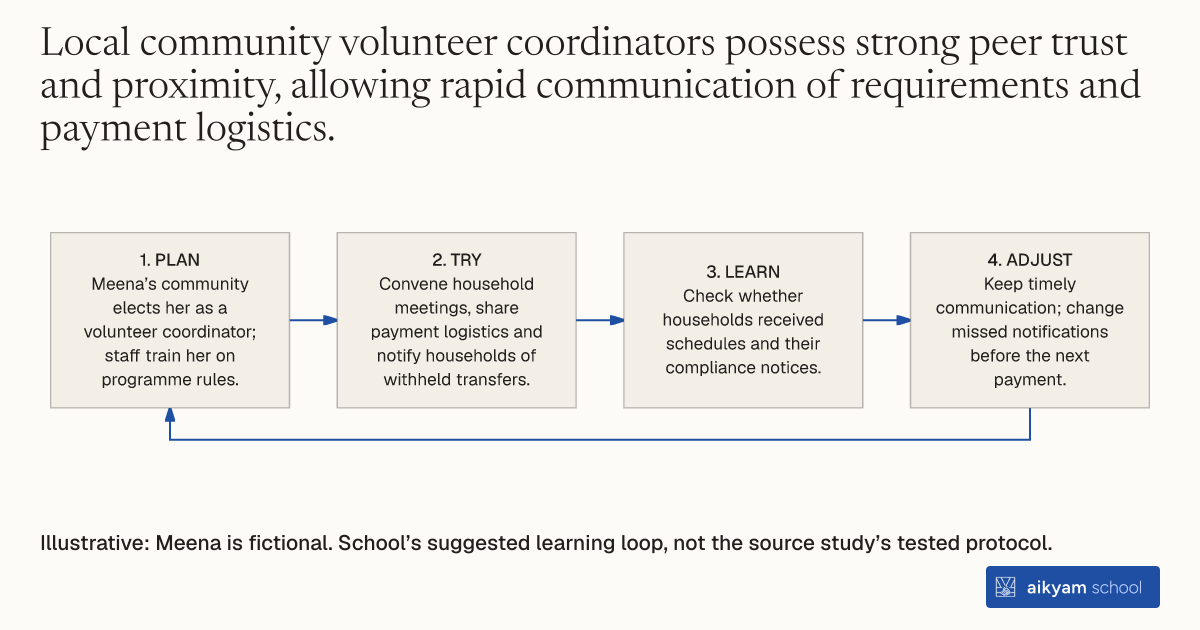
Try, learn and adjust
Check volunteer coordinators relay payment information
- Plan: Meena’s community elects her as a volunteer coordinator; staff train her on programme rules.
- Try: Convene household meetings, share payment logistics and notify households of withheld transfers.
- Learn: Check whether households received schedules and their compliance notices.
- Adjust: Keep timely communication; change missed notifications before the next payment.
Illustrative: Meena is fictional. School’s suggested learning loop, not the source study’s tested protocol.
See source →Payment information, compliance notices and meeting communication. School’s suggested learning loop, not a source-tested cycle.
How
When to use
Social protection programs in remote rural areas often struggle to communicate payment schedules, conditionalities, and compliance failures to beneficiary households. Local administrative staffing is expensive and lacks community trust. Managing a network of elected local female volunteers bridges the communication gap between program staff and beneficiary women.
Recruit and manage local female volunteer coordinators in targeted communities to organize beneficiary households, communicate program requirements, and monitor conditionalities.
- Beneficiary women in targeted rural localities elect a peer from their community to serve as the local volunteer coordinator.
- Program administrators train elected volunteer coordinators on program conditionalities, payment schedules, and monitoring procedures.
- Volunteer coordinators organize their assigned group of household representatives and convene regular local group meetings.
- Volunteer coordinators inform beneficiary women about upcoming cash transfer disbursement dates and location logistics.
- Volunteer coordinators receive non-compliance reports from central administration and notify specific households when transfers are withheld due to unfulfilled conditions.
- Volunteer coordinators assist local healthcare providers and schools in scheduling preventive health visits and tracking school attendance.
Why it works
Their active peer monitoring ensures high compliance with health and education conditions across scattered rural communities.
Example
In six rural municipalities in central and northern Nicaragua, the Red de Protección Social established a network of beneficiary-elected volunteer coordinators across 42 comarcas. These volunteer coordinators organized household representatives, resulting in an 85 percent program take-up rate and high compliance with health checkups and school attendance requirements.
About the study
Participants
Beneficiary households across 42 rural comarcas containing approximately 250 households each in central and northern Nicaragua.
Study Design
Randomized clustered trial evaluating program implementation supported by community-elected promotoras who managed local groups of beneficiary household representatives.
Results
Utilizing community promotoras to manage local groups helped achieve an 85 percent overall household program take-up rate and maintained baseline sample balance across 42 localities.