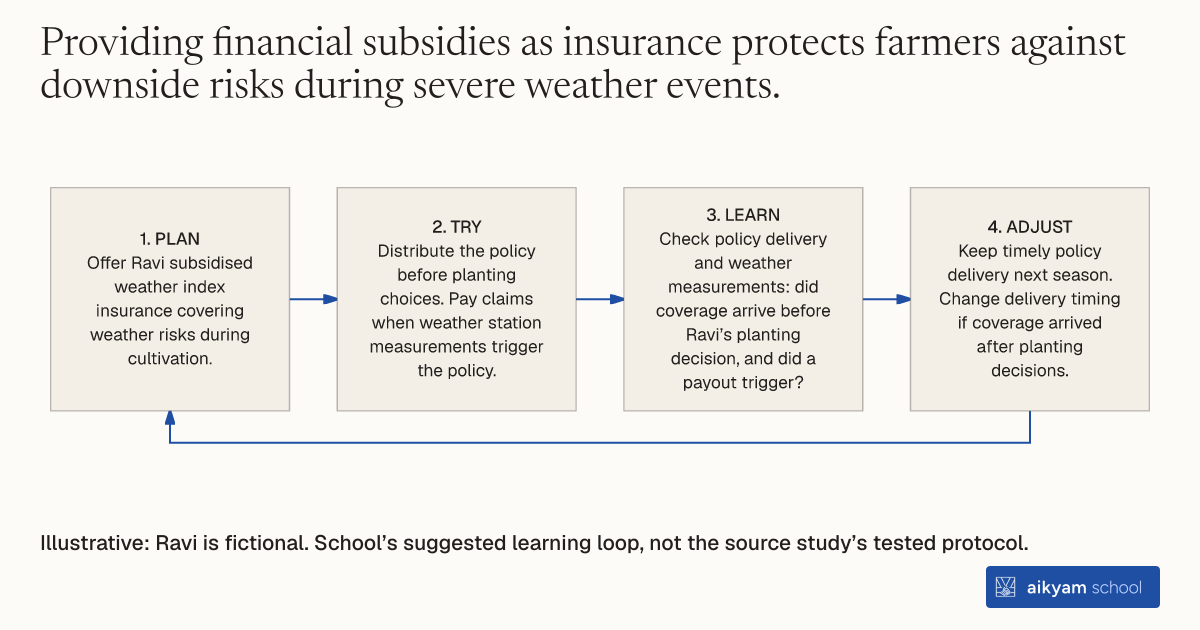
Try, learn and adjust
Check insurance arrives before planting decisions
- Plan: Offer Ravi subsidised weather index insurance covering weather risks during cultivation.
- Try: Distribute the policy before planting choices. Pay claims when weather station measurements trigger the policy.
- Learn: Check policy delivery and weather measurements: did coverage arrive before Ravi’s planting decision, and did a payout trigger?
- Adjust: Keep timely policy delivery next season. Change delivery timing if coverage arrived after planting decisions.
Illustrative: Ravi is fictional. School’s suggested learning loop, not the source study’s tested protocol.
See source →School’s suggested, untested loop. Observe policy timing, weather triggers and payouts; do not assume Ravi changes crops.
How
When to use
Smallholder farmers in low-income regions often avoid planting high-yield cash crops due to fear of crop failure from adverse weather. Offering weather insurance subsidized as an alternative to unconditional cash transfers encourages farmers to make more risk-tolerant agricultural choices.
Offer subsidized weather index insurance to farmers to incentivize shifting crop cultivation toward weather-sensitive cash crops.
- Identify smallholder farmers who cultivate low-yielding staple crops to avoid climate shocks.
- Design a weather index insurance policy covering weather risks during the cultivation season.
- Provide insurance premium subsidies to farmers as an alternative to unconditional cash grants.
- Distribute insurance policies to farmers before planting decisions are finalized.
- Disburse index payouts to policyholders whenever weather station metrics trigger claims.
Why it works
This protection nudges farmers to invest in higher-risk, higher-reward production choices.
Example
In Andhra Pradesh, India, researchers offered smallholder farmers subsidized weather index insurance while giving a comparison group cash grants of equal value. Farmers who took up insurance were 6 percentage points (12 percent) more likely to plant weather-sensitive cash crops like sesame relative to the comparison group mean of 45 percent.