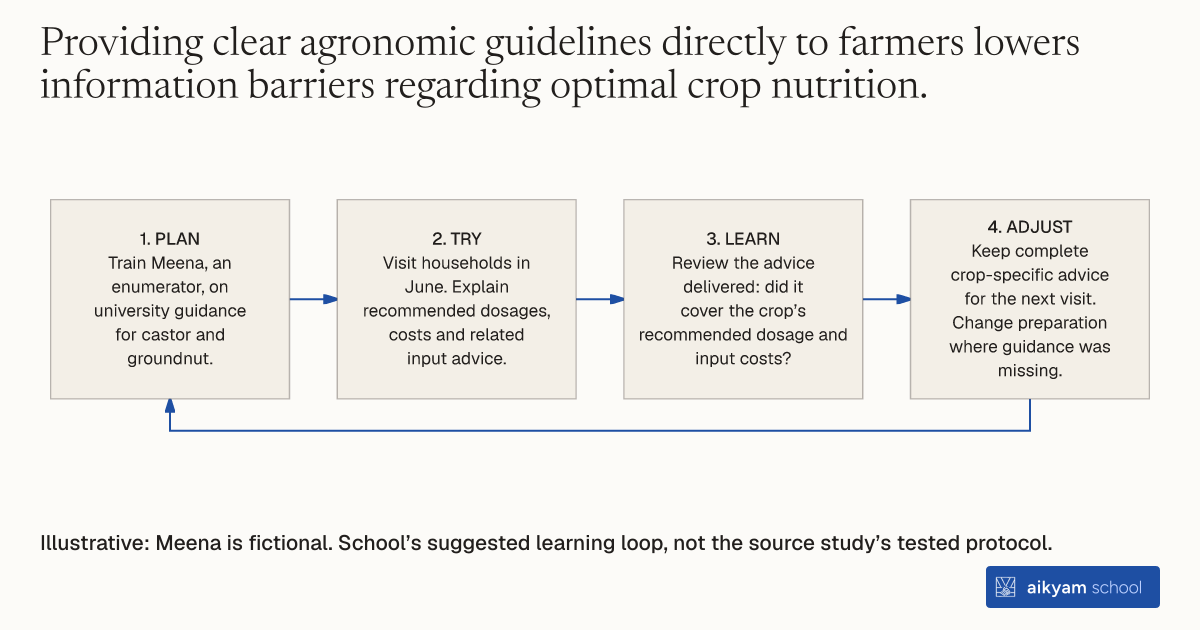
Try, learn and adjust
Check crop-specific fertiliser advice
- Plan: Train Meena, an enumerator, on university guidance for castor and groundnut.
- Try: Visit households in June. Explain recommended dosages, costs and related input advice.
- Learn: Review the advice delivered: did it cover the crop’s recommended dosage and input costs?
- Adjust: Keep complete crop-specific advice for the next visit. Change preparation where guidance was missing.
Illustrative: Meena is fictional. School’s suggested learning loop, not the source study’s tested protocol.
See source →School’s suggested, untested loop. Observe delivery of university guidance. Fertiliser use across the sample does not isolate the advisory’s effect.
How
When to use
Smallholder farmers often apply non-optimal fertilizer quantities due to lack of agronomic information regarding specific crop nutrient requirements. Inadequate or improper fertilizer usage limits crop yields and reduces profit margins on cash crops. Trained field staff deliver standardized agronomic dosage recommendations directly to farmers at the start of the planting season to improve nutrient application decisions.
Deliver standardized crop-specific fertilizer dosage guidelines to agricultural producers during household visits prior to monsoon planting.
- Hire and train field enumerators on official university extension guidelines for regional rain-fed cash crops.
- Visit smallholder farming households individually in their homes in June at the onset of the monsoon.
- Identify the main rain-fed cash crops grown in the local region, specifically castor and groundnut.
- Explain the exact recommended fertilizer dosages per hectare based on agricultural university research guidelines.
- Provide cost estimates and application advice for organic manure and inorganic fertilizers alongside seed and labor recommendations.
Why it works
Standardized extension advice ensures producers understand the recommended input expenditures required to maximize yields for high-value cash crops.
Example
Field enumerators from ICRISAT visited 1,479 farming households in Mahbubnagar and Anantapur, Andhra Pradesh, India, in June 2009. Enumerators explained recommended fertilizer dosages for castor (Rs. 3,125 per hectare for fertilizer, Rs. 1,250 for manure) and groundnut (Rs. 2,500 per hectare for fertilizer, Rs. 625 for manure). Following the intervention, 95% of surveyed farmers used inorganic fertilizer during the monsoon season, spending an average of Rs. 3,156 on fertilizer across all crops.
About the study
Participants
1,479 smallholder farming households across 45 villages in Mahbubnagar and Anantapur, Andhra Pradesh, India; 54% unschooled, average landholding 5.37 acres.
Study Design
Randomized Controlled Trial incorporating standardized agronomic advisories delivered uniformly across treatment and control groups during pre-monsoon household visits.
Results
Across the sample, 95% of farmers applied fertilizer during the 2009 monsoon season, allocating an average market value of Rs. 3,208 across all crops and Rs. 1,098 specifically for cash crops.