Research procedure
Separate parental wishes from expectations
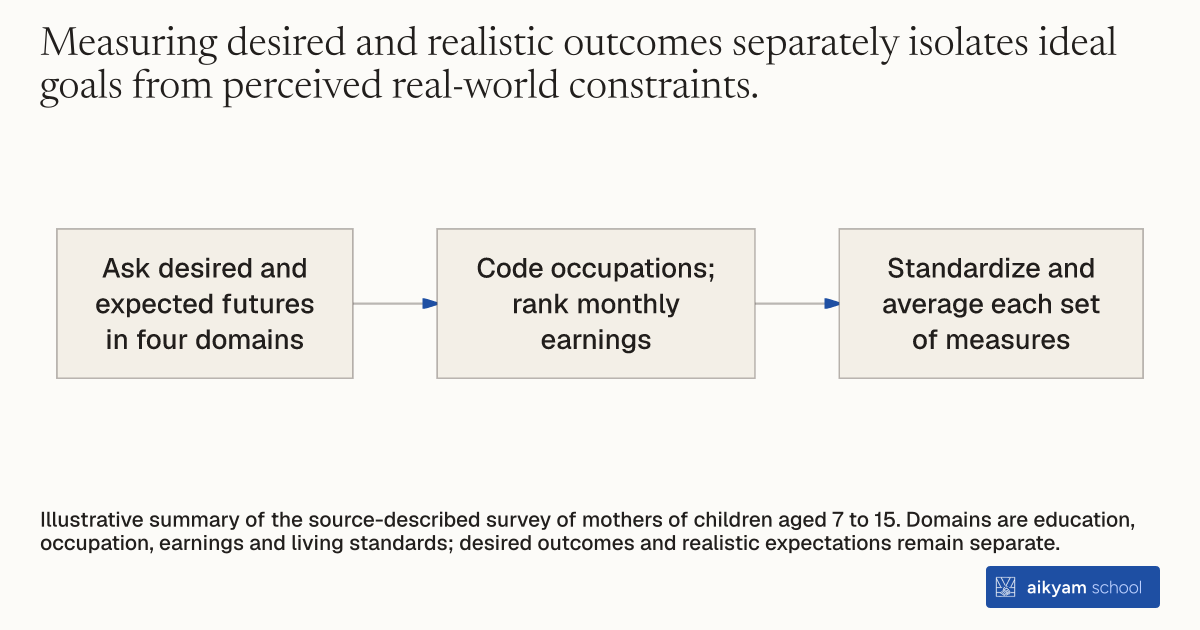
- Ask desired and expected futures in four domains
- Code occupations; rank monthly earnings
- Standardize and average each set of measures
Illustrative summary of the source-described survey of mothers of children aged 7 to 15. Domains are education, occupation, earnings and living standards; desired outcomes and realistic expectations remain separate.
See source →How
When to use
Social interventions often aim to alter long-term parental attitudes, but psychological mindsets are difficult to quantify. Unmeasured aspirations prevent evaluators from determining whether human capital gains stem from altered parental beliefs or temporary cash injections. Use this survey methodology to assess long-term expectations and aspirations among primary caregivers with school-aged children.
Administer a structured survey module to primary female caregivers to evaluate desired and expected future outcomes for their children.
- Target mothers with children between seven and fifteen years old during household survey rounds.
- Ask mothers to state their desired future outcomes for each child regarding total educational attainment, occupation, monthly earnings, and adult living standards.
- Ask mothers to separately report realistic expected future outcomes for each child across the identical four domains, accounting for current household constraints.
- Categorize desired and expected occupations into binary indicators for professional jobs requiring university education or skilled salary employment requiring secondary education.
- Convert expected and desired monthly earnings into rank metrics within the sample earnings distribution to address skewed income data.
- Calculate aggregate z-scores for aspirations and expectations by averaging standardized measures across the four outcome domains against control group means.
Why it works
Standardizing multi-domain responses into composite z-score indices prevents false discoveries from multiple hypothesis testing while capturing subtle attitudinal shifts.
Example
In 2008, survey teams administered the expectations and aspirations module to mothers of 4,304 children aged seven to fifteen across six municipalities in northwestern Nicaragua two years after cash transfers ended.
About the study
Participants
4,304 children aged 7 to 15 and their primary female caregivers across 106 rural communities in 6 municipalities of northwestern Nicaragua.
Study Design
Survey module administered two years post-treatment, comparing standardized z-score indices between randomized treatment arms and control households.
Results
Full exposure to leaders with the largest package increased parental expectations by 0.267 standard deviations and parental aspirations by 0.205 standard deviations.