Research steps
Measure several domains after therapy
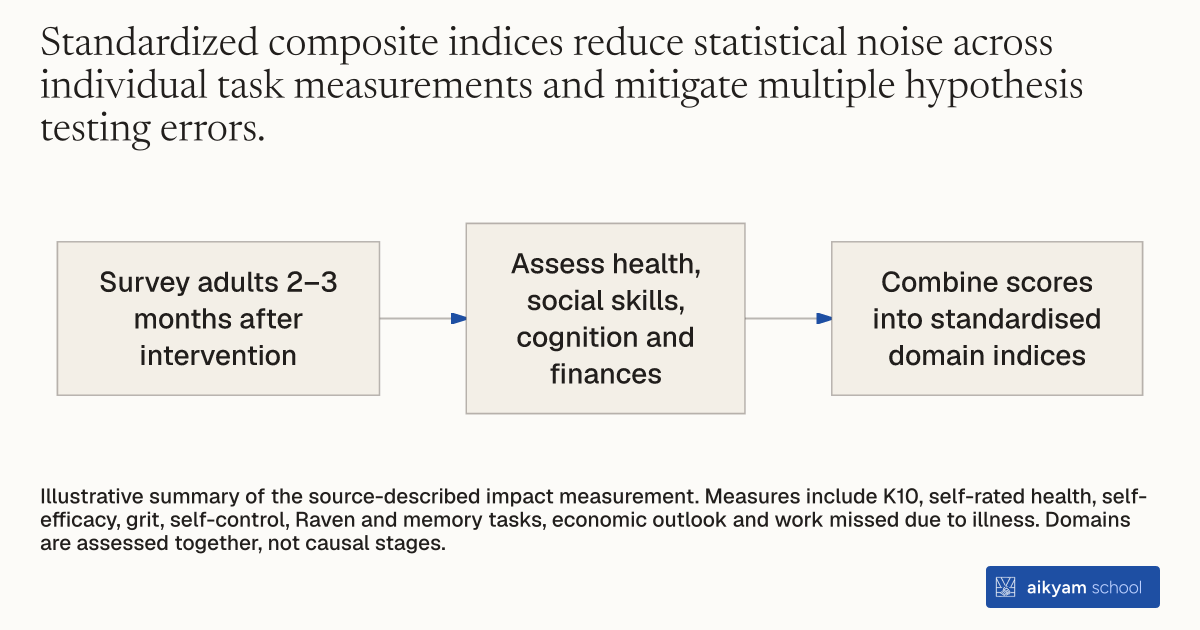
- Survey adults 2–3 months after intervention
- Assess health, social skills, cognition and finances
- Combine scores into standardised domain indices
Illustrative summary of the source-described impact measurement. Measures include K10, self-rated health, self-efficacy, grit, self-control, Raven and memory tasks, economic outlook and work missed due to illness. Domains are assessed together, not causal stages.
See source →How
When to use
Evaluation programs often measure mental health interventions solely by symptoms of clinical illness. Evaluators need a multidimensional framework to assess how therapy expands human capital and decision-making bandwidth across a general low-income population.
Measure multi-domain impacts using standardized aggregate indices for psychological health, cognitive executive function, non-cognitive socioemotional skills, and economic status.
- Administer adult surveys 2–3 months post-intervention to gather individual health, cognitive, and economic data.
- Measure mental health using the Kessler K10 distress scale, self-rated health questions, and monthly days without poor mental health.
- Measure socioemotional skills by constructing sub-indices for generalized self-efficacy, grit, and self-control.
- Assess cognitive skills using Raven's Progressive Matrices, forward and backward digit span tests, and a Stroop-like executive function task.
- Evaluate downstream economic status using Cantril's ladder current and 5-year projected scores and regular work days missed due to illness.
- Aggregate individual test scores into standardized indices following the Kling, Liebman, and Katz (2007) methodology.
Why it works
Assessing socioemotional and cognitive skills captures structural gains in decision-making bandwidth that drive economic behavior independent of baseline clinical distress.
Example
Innovations for Poverty Action surveyed 7,445 adults across 258 Ghanaian communities 2–3 months after a 12-week CBT program, evaluating standardized summary indices across mental health, physical health, socioemotional skills, cognition, and economic outcomes.
About the study
Participants
7,445 adults from poor households across 258 rural communities in Ghana.
Study Design
Randomized controlled trial comparing CBT participants to control individuals, estimating intent-to-treat effects across five standardized aggregate indices using randomization inference.
Results
Increased socioemotional skills index by 0.27 standard deviations, cognitive index by 0.08 standard deviations, mental health index by 0.15 standard deviations, physical health index by 0.15 standard deviations, and economic outcomes index by 0.19 standard deviations.