Try, learn and adjust
Check old yarn is catalogued and cleared
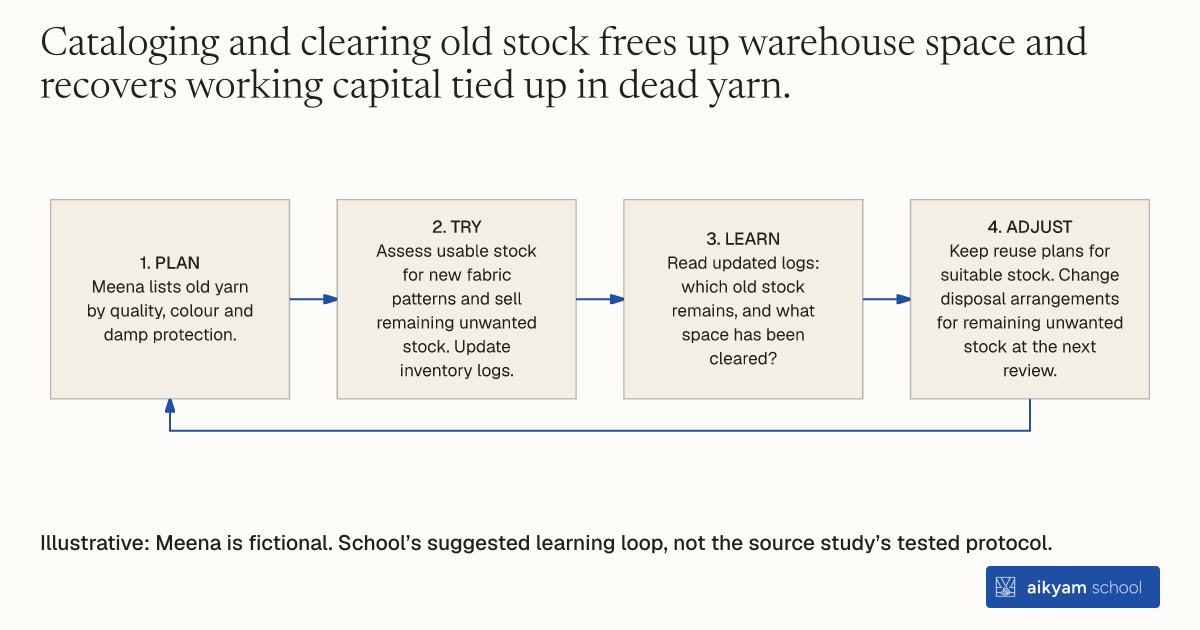
- Plan: Meena lists old yarn by quality, colour and damp protection.
- Try: Assess usable stock for new fabric patterns and sell remaining unwanted stock. Update inventory logs.
- Learn: Read updated logs: which old stock remains, and what space has been cleared?
- Adjust: Keep reuse plans for suitable stock. Change disposal arrangements for remaining unwanted stock at the next review.
Illustrative: Meena is fictional. School’s suggested learning loop, not the source study’s tested protocol.
See source →Observe old stock, reuse decisions and updated inventory levels. School suggests this learning loop; it is not the source’s tested procedure.
How
When to use
Textile factories frequently accumulate old yarn and dead stock across warehouse corners because managers lack systematic stock reviews. Unusable yarn ties up cash and occupies valuable storage space, while usable old stock is overlooked during new production orders. This method helps plant directors establish procedures to catalog, reuse in new fabric designs, or sell off surplus yarn stock.
Establish formal procedures to identify, catalog, reuse, or liquidate obsolete inventory across factory storage areas.
- Storekeepers catalog all old yarn stock lying in warehouse storage locations.
- Inventory staff categorize old stock by yarn quality, color, and degree of damp protection.
- Design teams evaluate old yarn cones to incorporate suitable stocks into new fabric patterns.
- Warehouse managers sell off remaining unneeded dead stock to outside buyers.
- Store clerks update inventory logs to reflect cleared storage space and reduced stock levels.
Why it works
Incorporating usable surplus yarn into new fabric designs lowers raw material purchasing costs for upcoming production runs.
Example
International consultants helped Indian cotton textile plants catalog long-forgotten yarn piles, enabling plant managers to sell off surplus yarn and incorporate old stock into new fabric patterns.
About the study
Participants
28 plants across 17 large, family-owned cotton textile weaving firms in Tarapur and Umbergaon near Mumbai, India, averaging 273 employees and $7.45 million in annual sales per firm.
Study Design
Randomized controlled trial providing 11 treatment firms with 5 months of management consulting and 6 control firms with 1 month of diagnostic consulting, tracking weekly data across ~100 weeks.
Results
Adopting old stock disposal and reuse systems contributed to a 21.7% reduction in yarn inventory (p = 0.060), while raising adoption of systems for using and disposing of old stock from 0% to 61.5% in treatment plants.