Try, learn and adjust
Check yarn locations before new purchases
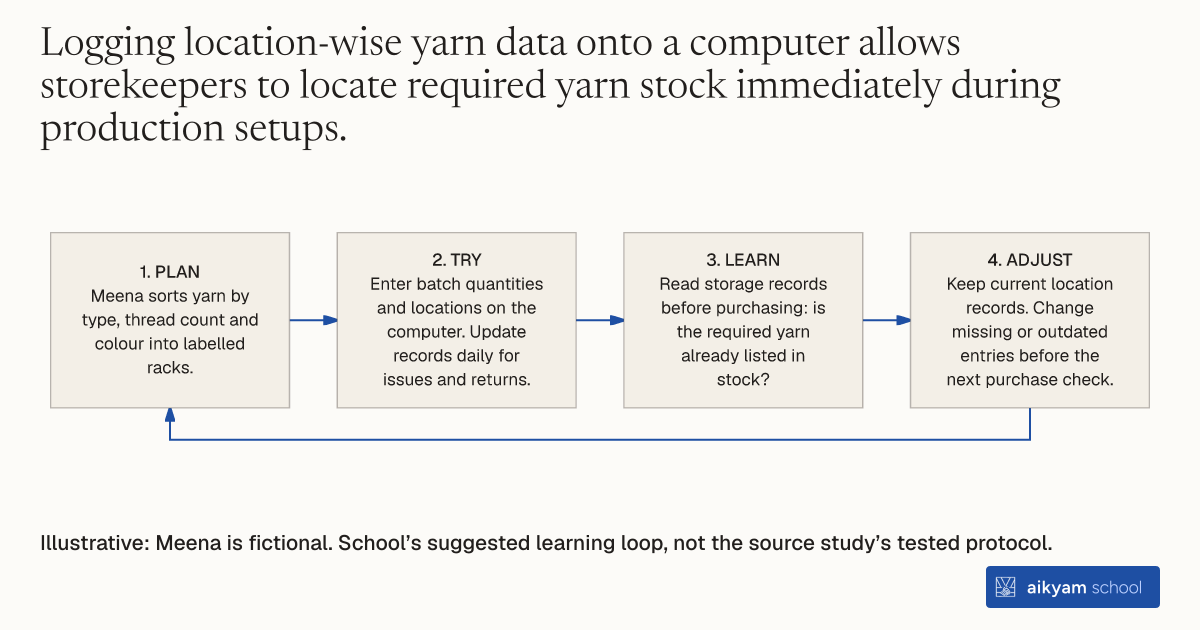
- Plan: Meena sorts yarn by type, thread count and colour into labelled racks.
- Try: Enter batch quantities and locations on the computer. Update records daily for issues and returns.
- Learn: Read storage records before purchasing: is the required yarn already listed in stock?
- Adjust: Keep current location records. Change missing or outdated entries before the next purchase check.
Illustrative: Meena is fictional. School’s suggested learning loop, not the source study’s tested protocol.
See source →Observe yarn quantities, rack locations and daily updates. School suggests this learning loop; it is not the source’s tested procedure.
How
When to use
Textile plants frequently store raw yarn cones piled high across multiple warehouse rooms without labeling or location logging. Storekeepers cannot locate specific yarn colors or types during weaving orders, leading to lost time and unnecessary purchases of duplicate yarn. This method helps factory managers categorize yarn by type and color, assign designated storage locations, and log location records into a computer system.
Sort and label yarn stocks in designated warehouse locations and log location data into a computer to maintain inventory visibility.
- Warehouse staff sort yarn cones by type, thread count, and color upon arrival at the factory.
- Storekeepers assign specific racks and demarked warehouse storage locations for each sorted yarn batch.
- Inventory clerks enter yarn batch details, stock quantities, and designated rack locations into a computer system.
- Storekeepers update computer location entries daily whenever yarn is issued to looms or returned unused.
- Production managers check computer storage records prior to issuing new yarn purchasing orders to prevent duplicate buys.
Why it works
Maintaining computerized storage records prevents yarn from being misplaced or accumulating as forgotten dead stock in warehouse corners.
Example
International consultants guided woven cotton textile plants near Mumbai, India to sort mixed yarn piles and set up computer-based location logging, increasing computerized location entry adoption from 35.7% to 71.4% in treatment plants.
About the study
Participants
28 plants across 17 large, family-owned cotton textile weaving firms in Tarapur and Umbergaon near Mumbai, India, averaging 273 employees and \$7.45 million in annual sales per firm.
Study Design
Randomized controlled trial providing 11 treatment firms with 5 months of management consulting and 6 control firms with 1 month of diagnostic consulting, tracking weekly data across ~100 weeks.
Results
Adopting computerized location-wise yarn entry contributed to a 21.7% reduction in yarn inventory (p = 0.060), equivalent to roughly \$100,000 per plant, while raising location-wise entry adoption from 35.7% to 71.4% (a 35.7 percentage point increase) in treatment plants.