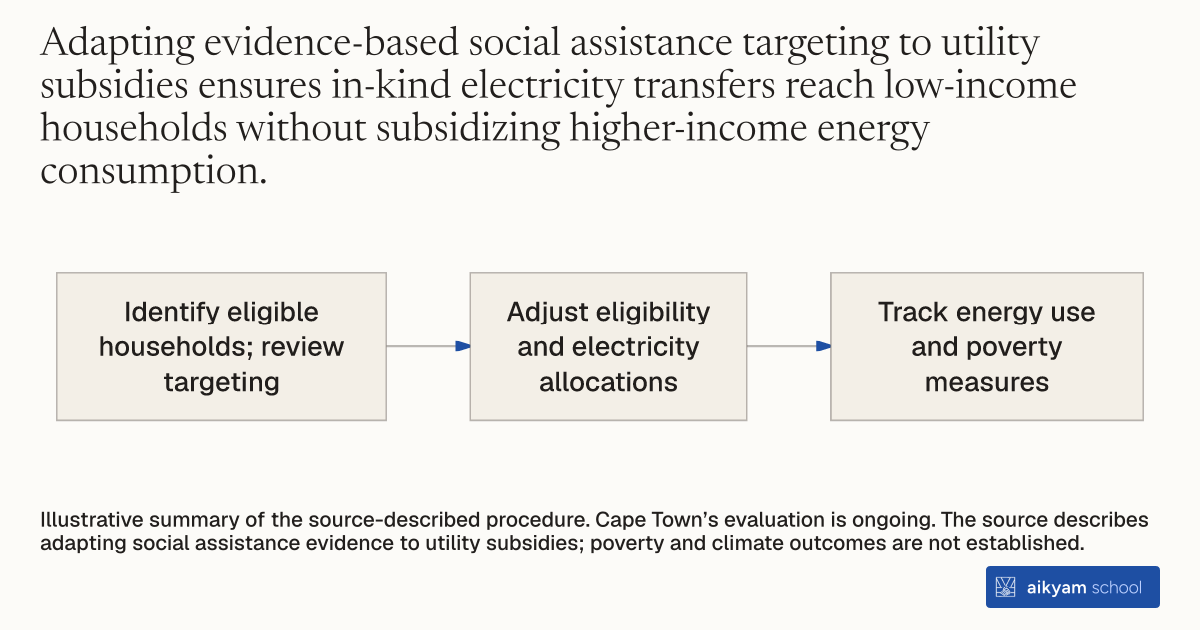
Research steps
Evaluate free electricity targeting
- Identify eligible households; review targeting
- Adjust eligibility and electricity allocations
- Track energy use and poverty measures
Illustrative summary of the source-described procedure. Cape Town’s evaluation is ongoing. The source describes adapting social assistance evidence to utility subsidies; poverty and climate outcomes are not established.
See source →How
When to use
Nationally mandated utility subsidies often allocate free basic electricity inefficiently across urban households. Un-targeted or poorly designed in-kind power transfers fail to alleviate poverty while straining municipal budgets and climate targets. This method applies to municipal utility authorities seeking to optimize electricity subsidy allocation for low-income urban residents.
Redesign in-kind electricity transfers by adapting social assistance targeting mechanisms to allocate free basic power to vulnerable urban households.
- The municipal government identifies low-income urban households entitled to nationally mandated free basic electricity.
- Program officers evaluate social assistance targeting framework designs to inform utility subsidy allocation.
- The municipal power utility adjusts household eligibility criteria and electricity transfer thresholds.
- The utility dispenses targeted in-kind electricity allocations directly to qualifying low-income accounts.
- Program staff evaluate household energy consumption and poverty alleviation metrics in Cape Town, South Africa.
Why it works
Optimized targeting helps municipalities achieve poverty reduction and carbon neutrality goals simultaneously.
Example
In Cape Town, South Africa, municipal officials partnered with researchers to adapt social assistance targeting evidence to inform the design and allocation of nationally mandated free basic electricity.
About the study
Participants
Low-income urban households and utility customers in Cape Town, South Africa.
Study Design
Randomized field evaluation adapting social assistance evidence to optimize the allocation of nationally mandated free basic electricity transfers.
Results
Ongoing evaluation analyzing the impact of improved electricity subsidy allocation on household poverty alleviation and municipal carbon neutrality goals by 2050.