Research procedure
Test cards restricted to the poorest households
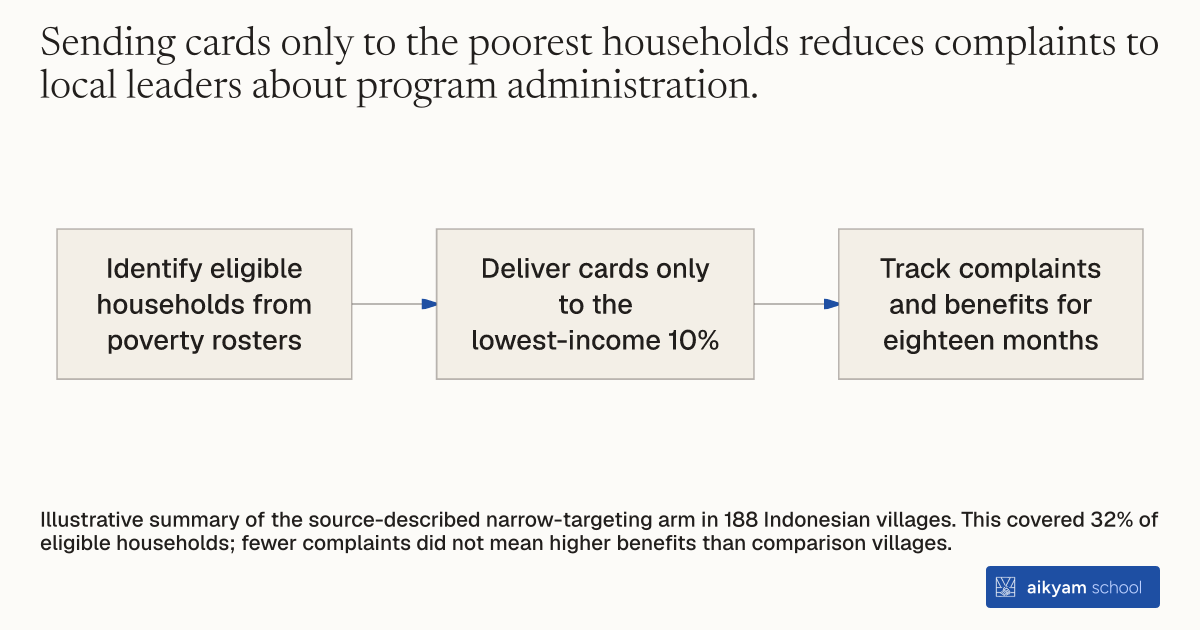
- Identify eligible households from poverty rosters
- Deliver cards only to the lowest-income 10%
- Track complaints and benefits for eighteen months
Illustrative summary of the source-described narrow-targeting arm in 188 Indonesian villages. This covered 32% of eligible households; fewer complaints did not mean higher benefits than comparison villages.
See source →How
When to use
Governments may attempt to limit administrative costs by distributing benefit cards only to the poorest fraction of eligible households. Restricting information to a narrow group can fail to shift community-wide bargaining power or increase benefit receipts. Restrict identification cards to the lowest-income subset of eligible beneficiaries to evaluate narrow targeting strategies.
Target benefit identification cards exclusively to the poorest subset of eligible program beneficiaries.
- Identify all eligible low-income households in target villages using government poverty rosters.
- Filter the recipient list to select households in the lowest 10 percent of the income distribution.
- Mail or deliver official benefit cards directly to these lowest-income households.
- Withhold cards from eligible middle-income households in the same communities.
- Monitor changes in beneficiary complaints and total benefits received over eighteen months.
Why it works
However, it fails to increase overall benefits because bargaining power depends on broader community awareness.
Example
In Indonesia, mailing benefit cards only to households in the lowest 10 percent of income in 188 villages led to fewer complaints to local leaders. However, these households received no additional benefits compared to villages where no cards were sent.
About the study
Participants
188 villages in Indonesia where cards were restricted to the lowest 10 percent of the income distribution (representing 32 percent of Raskin-eligible households).
Study Design
Randomized controlled trial comparing villages receiving lowest-income targeting against villages receiving cards for all eligible households and comparison villages over an eighteen-month study period.
Results
Restricting cards to the poorest households caused no change in total benefits received compared to comparison villages, whereas middle-income eligible households gained benefits only when cards were sent to all eligible households.