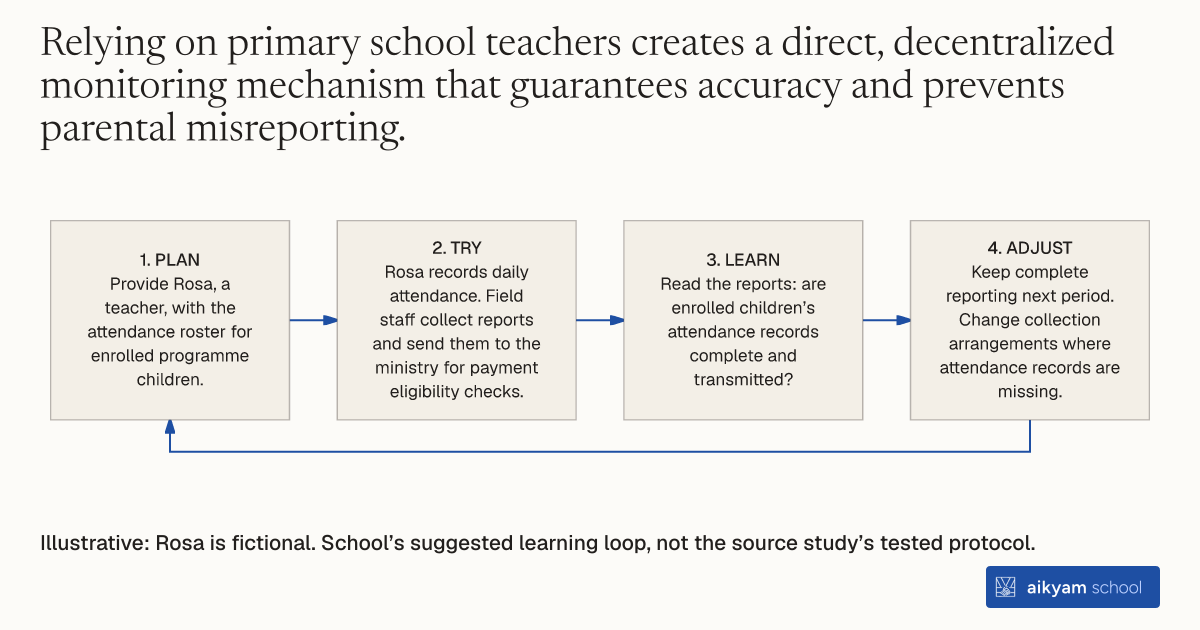
Try, learn and adjust
Check school attendance reports before payment
- Plan: Provide Rosa, a teacher, with the attendance roster for enrolled programme children.
- Try: Rosa records daily attendance. Field staff collect reports and send them to the ministry for payment eligibility checks.
- Learn: Read the reports: are enrolled children’s attendance records complete and transmitted?
- Adjust: Keep complete reporting next period. Change collection arrangements where attendance records are missing.
Illustrative: Rosa is fictional. School’s suggested learning loop, not the source study’s tested protocol.
See source →School’s suggested, untested loop. Observe daily attendance records, report collection and transmission; this does not prove changes in child labour.
How
When to use
Conditional cash transfer programs require verifiable compliance to ensure parents keep children enrolled and attending primary school. Self-reporting by parents is unreliable, and external inspections can be expensive or infrequent. Utilizing local primary school teachers to track daily attendance and transmit compliance records to program administrators enforces educational conditions directly at the classroom level.
Enforce conditional cash transfer schooling rules by having local primary school teachers log daily student attendance and report compliance directly to program administrators.
- Enroll primary-school-age children living in targeted beneficiary households into local primary schools.
- Provide classroom teachers with standardized attendance rosters for all enrolled program children.
- Require primary school teachers to record daily student attendance during regular school hours.
- Collect attendance records periodically from primary school teachers through program field staff.
- Transmit verified attendance reports to the executing ministry to determine bi-monthly cash transfer eligibility.
Why it works
Knowing attendance is recorded daily motivates parents to keep children in class, directly substituting school time for agricultural labor.
Example
In rural northwest Nicaragua, the Ministry of the Family monitored school compliance for children aged 7 to 15 across 56 intervention communities in the Atención a Crisis program. Primary school teachers recorded student attendance and submitted data to the ministry, ensuring cash transfers were released only to compliant households.
About the study
Participants
3,000 eligible households with children aged 7 to 15 in 56 intervention communities across 6 rural municipalities in northwest Nicaragua.
Study Design
Randomized controlled trial tracking 4,400 panel households, with teacher attendance reporting serving as the core mechanism to enforce school conditionalities for 88 percent of binding eligible children.
Results
Teacher-based monitoring was successfully implemented across all treatment schools, driving higher school enrollment and attendance, and contributing to a 1.5-hour weekly reduction in total child labor for older boys relative to girls.