Try, learn and adjust
Check attendance before education transfers
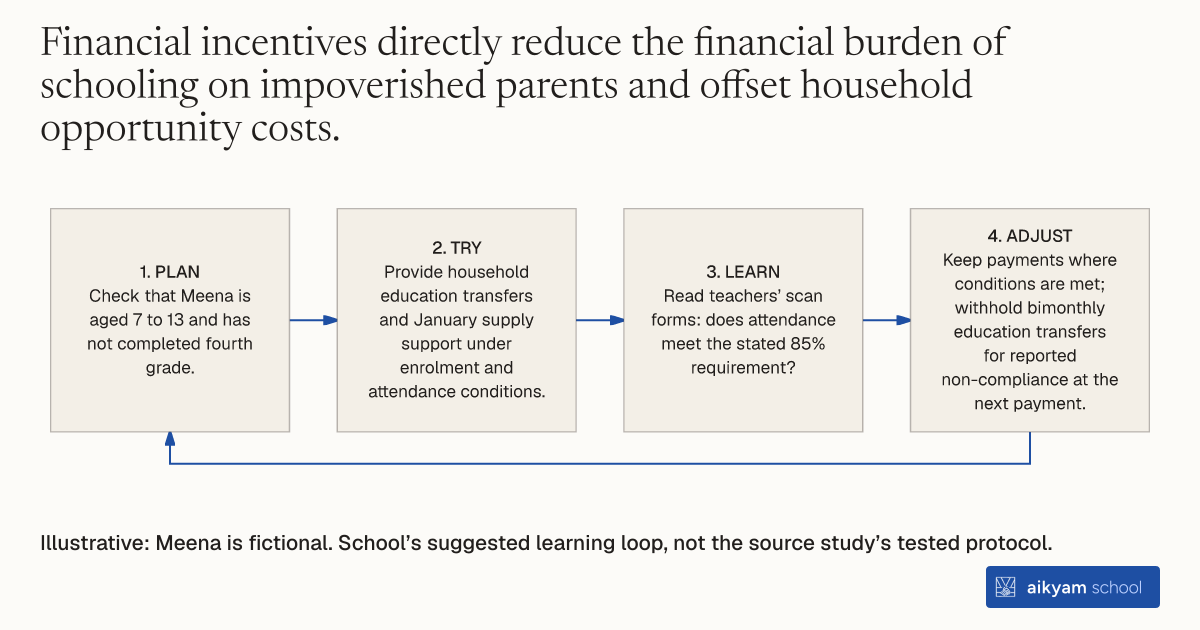
- Plan: Check that Meena is aged 7 to 13 and has not completed fourth grade.
- Try: Provide household education transfers and January supply support under enrolment and attendance conditions.
- Learn: Read teachers’ scan forms: does attendance meet the stated 85% requirement?
- Adjust: Keep payments where conditions are met; withhold bimonthly education transfers for reported non-compliance at the next payment.
Illustrative: Meena is fictional. School’s suggested learning loop, not the source study’s tested protocol.
See source →School’s suggested, untested loop. Observe enrolment, attendance forms and conditional payments; the loop does not establish educational effects.
How
When to use
In rural developing regions with high dropout rates, poor families frequently withdraw primary school children due to costs of uniforms, supplies, and household opportunity costs. Conditional educational transfers offset these expenses by tying cash grants directly to school enrollment and regular attendance for children aged 7 to 13.
Provide bimonthly household cash grants and annual school supply stipends to rural families conditional on primary school enrollment and attendance of eligible children.
- Program administrators identify resident children aged 7 to 13 years who have not yet completed the fourth grade of primary school.
- Program administrators disburse a fixed bimonthly cash transfer of \$112 per year per eligible household, conditional on children maintaining regular school attendance above 85 percent of school days.
- Program administrators disburse an annual per-child cash transfer of \$21 at the start of the school year in January for uniforms and school supplies, conditional on school enrollment.
- Teachers monitor daily enrollment and classroom attendance using standardized program tracking scan forms.
- Program staff withhold bimonthly education transfers from households whenever teacher monitoring forms report non-compliance with the 85 percent attendance requirement.
Why it works
Regular attendance verification enforces attendance habits, preventing early primary school dropout.
Example
In rural Nicaragua, the Red de Protección Social program provided households in 21 early treatment localities with a bimonthly education transfer of \$112 per year and an annual supply transfer of \$21 per eligible child starting in November 2000. By 2002, eligible girls aged 9 to 12 increased regular attendance by 18 percentage points, grade attainment by 0.27 grades, and fourth-grade completion by 5 percentage points compared to late-treatment controls.
About the study
Participants
450 rural girls aged 9 to 12 at baseline across 42 comarcas in six municipalities in central and northern Nicaragua.
Study Design
Randomized clustered evaluation comparing early treatment households receiving transfers from 2000 to 2003 with late treatment households phased in from 2003 to 2005.
Results
Two years of early program exposure increased school attendance of more than 85 percent of time by 18 percentage points, school enrollment by 10 percentage points, literacy by 10 percentage points, and grades completed by 0.27 grades.