Research timing
Randomly assign SMS schedules
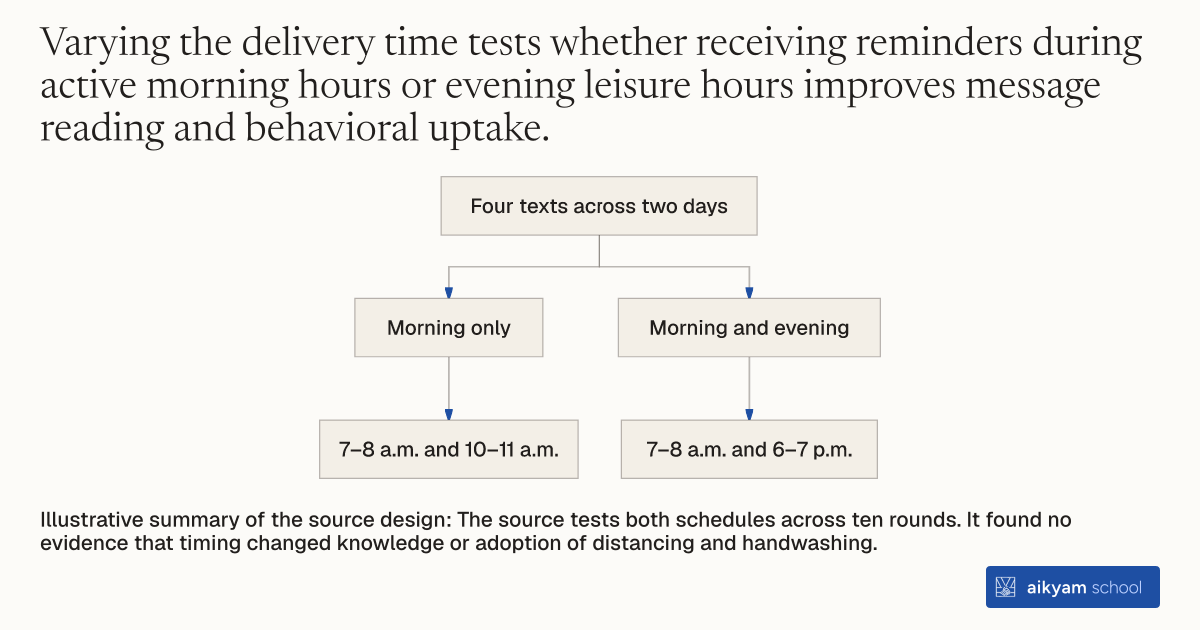
Four texts across two days
- Morning only
- 7–8 a.m. and 10–11 a.m.
- Morning and evening
- 7–8 a.m. and 6–7 p.m.
Illustrative summary of the source design: The source tests both schedules across ten rounds. It found no evidence that timing changed knowledge or adoption of distancing and handwashing.
See source →How
When to use
Health interventions delivered by mobile phone must determine when recipients are most receptive to reminders. Sending text messages at different times of day tests whether timing affects message attention and behavior change. Program managers use this method to evaluate morning versus evening SMS schedules for target populations.
Test alternative text message delivery schedules by randomizing the time of day recipients receive health nudges.
- Health officers define two distinct delivery timing schedules for text messages.
- Program staff set the morning-only schedule to send messages twice in the morning from 7 to 8 a.m. and 10 to 11 a.m.
- Program staff set the morning-evening schedule to send messages once in the morning from 7 to 8 a.m. and once in the evening from 6 to 7 p.m.
- Researchers randomly allocate target phone numbers in Saran, Bihar to receive four total messages across two days under one of the two time schedules.
Example
Researchers in Saran, Bihar randomly assigned 3,964 households to receive four text messages either twice in the morning or once in the morning and once in the evening over two days.
About the study
Participants
3,964 households in 15 blocks of Saran, Bihar, India.
Study Design
Randomized controlled trial assigning recipients to morning-only (7-8 a.m. and 10-11 a.m.) or morning-and-evening (7-8 a.m. and 6-7 p.m.) SMS delivery schedules across ten trial rounds.
Results
The study found no evidence that SMS delivery timing affected knowledge or adoption of social distancing and handwashing behaviors.