Try, learn and adjust
Check vaccine delivery within the campaign window
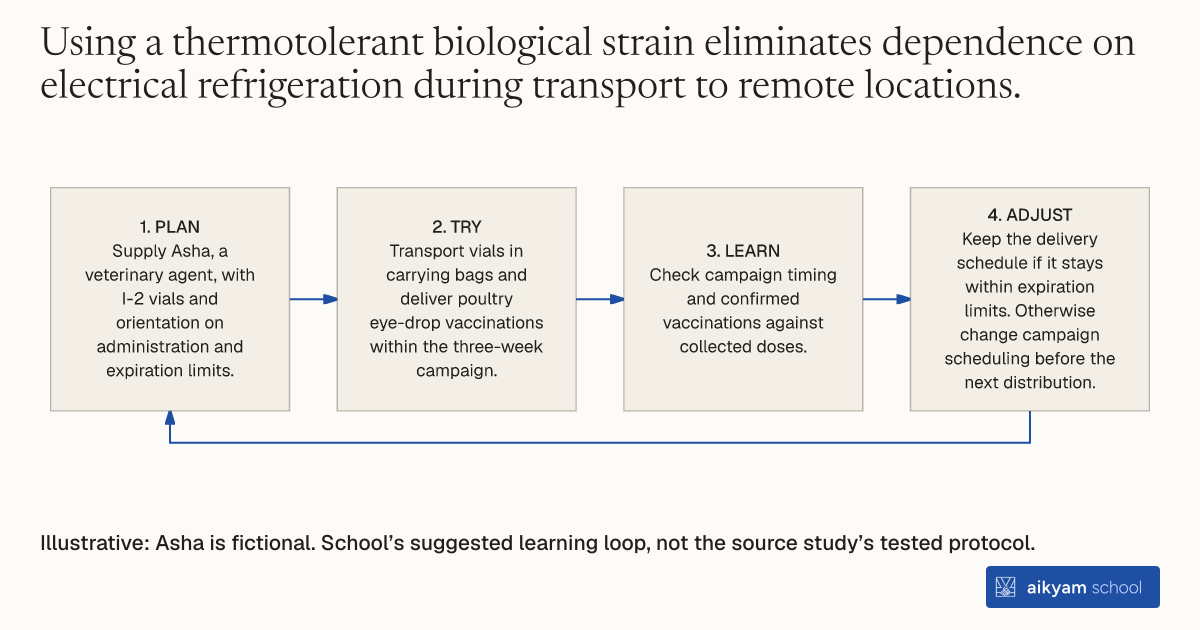
- Plan: Supply Asha, a veterinary agent, with I-2 vials and orientation on administration and expiration limits.
- Try: Transport vials in carrying bags and deliver poultry eye-drop vaccinations within the three-week campaign.
- Learn: Check campaign timing and confirmed vaccinations against collected doses.
- Adjust: Keep the delivery schedule if it stays within expiration limits. Otherwise change campaign scheduling before the next distribution.
Illustrative: Asha is fictional. School’s suggested learning loop, not the source study’s tested protocol.
See source →School’s suggested learning loop, not the source’s tested procedure. Observe campaign timing and the vaccine utilisation proxy. This is a logistics check, not a new vaccine administration protocol.
How
When to use
Rural smallholders lose significant livestock to lethal Newcastle Disease because standard vaccines require strict refrigeration. Delivering heat-tolerant vaccines allows mobile agents to travel into off-grid villages without cold-chain transport. This method applies when providing essential biological livestock health treatments across infrastructure-poor developing regions.
Distribute heat-tolerant eye-drop vaccines through mobile public agents to administer recurring poultry disease protection across off-grid rural communities.
- Ministry officials supply government veterinary extension agents with thermotolerant I-2 vaccine vials during centralized district distribution meetings.
- Training staff instruct agents on proper eye-drop administration techniques and vaccine expiration limits during orientation seminars.
- Extension agents transport vaccine vials in standard carrying bags directly to rural villages without refrigeration equipment.
- Agents visit smallholder farming households and apply individual vaccine drops directly into the eyes of poultry flocks.
- Agents complete village vaccination coverage within three weeks before heat exposure degrades the active biological formulation.
Why it works
Applying eye-drop doses directly to individual birds ensures effective viral protection without requiring farmers to perform technical medical procedures.
Example
The Ministry of Agriculture, Livestock and Fisheries in Tanzania distributed thermostable I-2 vaccines to 832 livestock extension agents across 550 administrative wards in four regions. Agents conducted a three-week campaign delivering 702,762 eye-drop vaccinations to poultry flocks across rural villages without cold-chain storage, achieving a 96% vaccine utilization proxy rate.
About the study
Participants
832 government livestock extension agents serving smallholder poultry farmers across 550 administrative wards in 27 districts of Tanzania (Dodoma, Iringa, Morogoro, and Tanga regions).
Study Design
Field experimental evaluation tracking I-2 thermotolerant vaccine distribution, agent participation, and campaign output across a 3-week campaign using SMS receipt logs and a 15% random sample follow-up survey of 3,580 farmers.
Results
Extension agents delivered 702,762 Newcastle Disease vaccinations across 31,657 recorded transactions during the 3-week campaign period. Control group agents served an average of 50.66 farmers and applied 1,154.47 vaccinations per agent, achieving a confirmed vaccine utilization proxy rate of 96% (0.96 ratio of confirmed vaccinations to collected doses) without cold-chain infrastructure.