Try, learn and adjust
Check provider payments against milestones
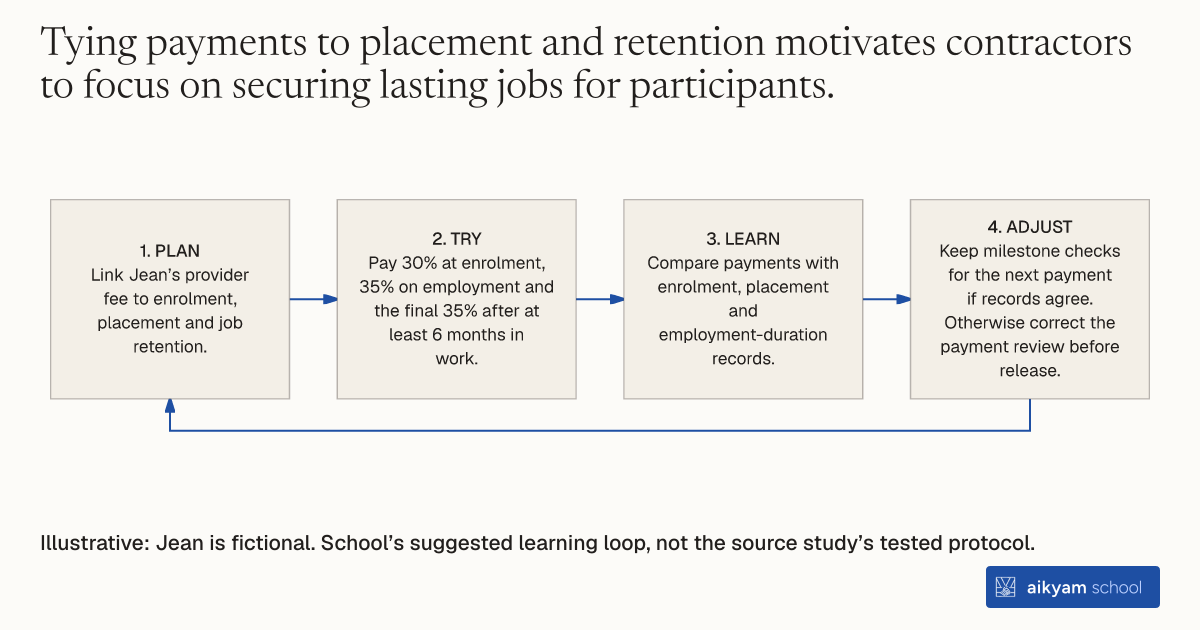
- Plan: Link Jean’s provider fee to enrolment, placement and job retention.
- Try: Pay 30% at enrolment, 35% on employment and the final 35% after at least 6 months in work.
- Learn: Compare payments with enrolment, placement and employment-duration records.
- Adjust: Keep milestone checks for the next payment if records agree. Otherwise correct the payment review before release.
Illustrative: Jean is fictional. School’s suggested learning loop, not the source study’s tested protocol.
See source →School’s suggested learning loop: observe milestone completion and fee payments; do not infer programme cost-effectiveness from payment compliance.
How
When to use
Public agencies contract job placement services out to private providers to share operational risks. Without performance targets, contractors might collect public fees without delivering real placement results. Structuring payments around milestone achievements aligns contractor earnings with job placement and long-term employment retention.
Structure private contractor remuneration into three distinct milestone payments tied to enrollment, initial placement, and long-term retention.
- Pay private contractors 30 percent of the total fee as an upfront fixed payment when a job seeker enrolls.
- Disburse 35 percent of the total fee when the job seeker finds any employment.
- Release the final 35 percent of the total fee when the job seeker retains employment for at least six months.
Why it works
Staggering disbursements prevents contractors from receiving full compensation without proving long-term employment success.
Example
UNEDIC implemented a three-tier performance contract in 2007 for private job counseling providers in France. Total payments per enrolled job seeker ranged from €900 to €3,947 based on whether the client achieved placement and six-month job retention.
About the study
Participants
Nearly 44,000 job seekers entering unemployment and entitled to at least one year of benefits across 216 local public employment offices in four French administrative regions.
Study Design
Randomized controlled trial conducted from January to December 2007 evaluating private contractor performance under a three-tiered payment structure compared to public counseling tracks.
Results
Under the three-tier payment contract (30 percent upfront, 35 percent on placement, 35 percent on six-month retention), private counseling increased total net expenses by approximately €1,162 per enrolled job seeker without reducing total benefit payout days.