Try, learn and adjust
Check peak cooling demand
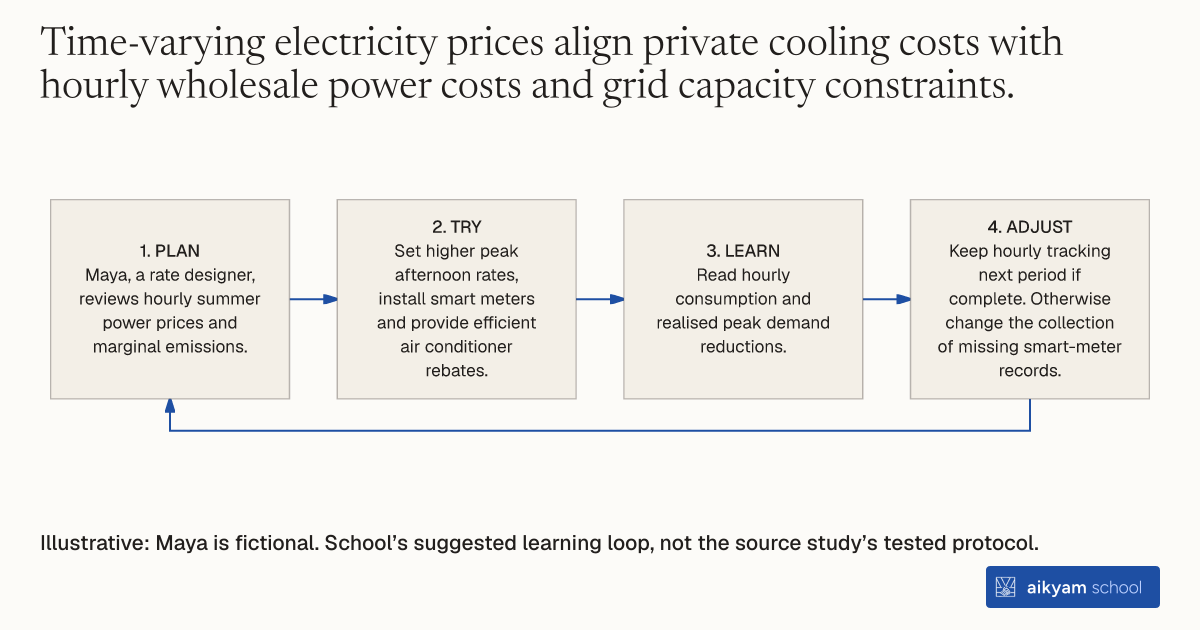
- Plan: Maya, a rate designer, reviews hourly summer power prices and marginal emissions.
- Try: Set higher peak afternoon rates, install smart meters and provide efficient air conditioner rebates.
- Learn: Read hourly consumption and realised peak demand reductions.
- Adjust: Keep hourly tracking next period if complete. Otherwise change the collection of missing smart-meter records.
Illustrative: Maya is fictional. School’s suggested learning loop, not the source study’s tested protocol.
See source →School’s suggested, untested learning loop. Observe hourly electricity use, peak demand and timing premiums; private and social benefits may differ.
How
When to use
Flat-rate electricity tariffs fail to reflect the high marginal cost and emissions of peak afternoon power generation during hot summer days. Consumers lack financial signals to lower air conditioning usage during peak demand hours, driving grid overload. Designing time-of-use electricity tariffs aligns private cooling demand with system-wide power costs.
Structure time-of-use electricity tariffs to capture the variable timing value of residential cooling efficiency.
- Electric utility regulators analyze hourly wholesale electricity prices and grid marginal emissions throughout summer months.
- Rate designers set higher electricity prices during peak afternoon hours when cooling demand drives generation capacity limits.
- Utility companies install smart meters across residential service areas to track hourly household electricity consumption.
- Program officers disburse targeted rebates for energy-efficient air conditioning units that reduce peak afternoon electricity draw.
- Utility analysts calculate realized peak demand reductions and timing premiums across participating residential customer cohorts.
Why it works
High peak rates incentivize households to reduce air conditioning usage when grid generation costs and emissions are highest.
Example
In California and Southern United States utility territories, evaluating energy-efficient air conditioning rebates under hourly smart-meter data revealed that accounting for hourly electricity price variation and forward capacity markets substantially altered the economic return of cooling efficiency investments.
About the study
Participants
Residential utility customers with smart meters across California and the Southern United States evaluating efficient air conditioning.
Study Design
Quasi-experimental panel regressions using hourly smart-meter billing datasets across 3 studies.
Results
Air conditioning efficiency retrofits reduced electricity consumption, but time-varying price differences created discrepancies between private and social benefits, creating timing premiums and incentives to overinvest under flat tariff structures.