Research follow-up
Locate families after the lottery
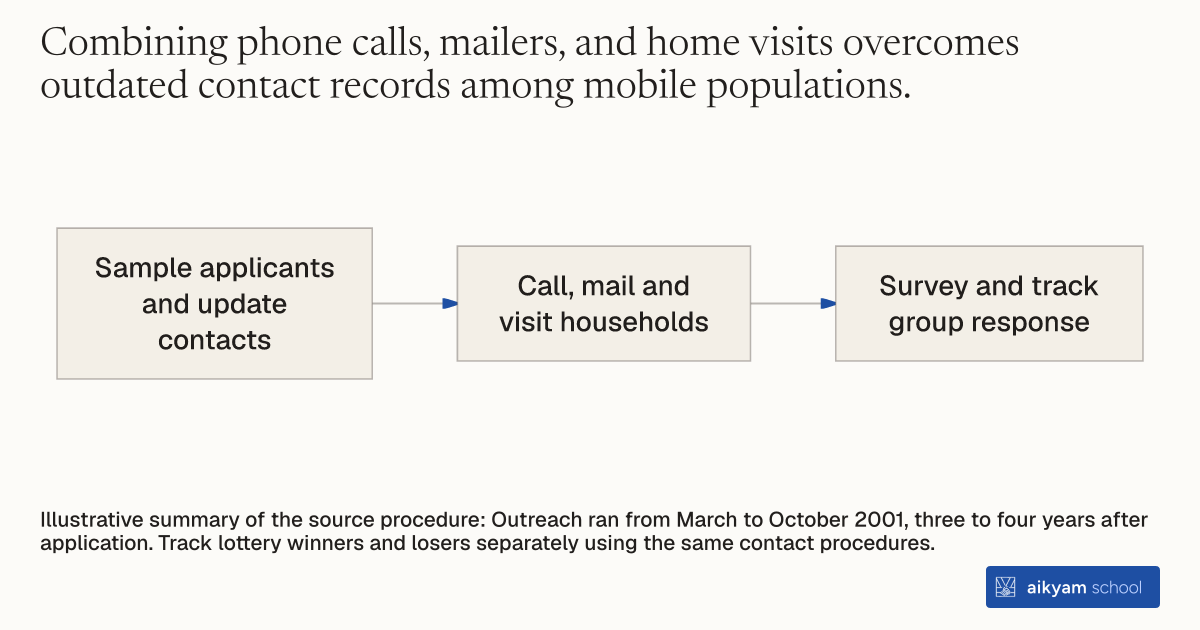
- Sample applicants and update contacts
- Call, mail and visit households
- Survey and track group response
Illustrative summary of the source procedure: Outreach ran from March to October 2001, three to four years after application. Track lottery winners and losers separately using the same contact procedures.
See source →How
When to use
Researchers need to track low-income families several years after an intervention to collect follow-up survey and experimental data. Contact information becomes outdated quickly as mobile families change residences over time. This method locates low-income households using multi-channel outreach to maintain high, symmetric response rates across treatment and control groups.
Locate and survey mobile low-income households three to four years after program application using targeted multi-channel outreach.
- Draw a random sample of applicant families from original program records three to four years after the initial intervention.
- Search public records, database tools, and locator resources to update missing addresses and phone numbers.
- Initiate preliminary contacts with families using phone calls, mailers, and household visits over an eight-month outreach window.
- Administer preliminary surveys to gather current household demographics and educational history.
- Offer financial compensation to incentivise event attendance, increasing show-up fees when initial response wanes.
- Track response rates separately across treatment and control groups to ensure balanced data collection.
Why it works
Maintaining identical contact protocols across winners and losers prevents non-response bias between comparison groups.
Example
Between March and October 2001, researchers in Toledo, Ohio, attempted to contact 438 low-income families whose contact details were three to four years old. Using phone, mail, and home visits, they achieved a 61 percent response rate among lottery losers and a 67 percent response rate among lottery winners despite over 25 percent of families having moved.
About the study
Participants
438 low-income applicant families representing almost 900 children in Toledo, Ohio, where 39 percent were single-parent homes and 57 percent were African-American.
Study Design
Multi-channel survey protocol utilizing phone calls, mail, and household visits conducted over eight months to track voucher lottery winners and losers three to four years after application.
Results
Reached a 61 percent survey response rate among unsuccessful applicants and a 67 percent response rate among successful applicants, with no statistically significant differences in baseline characteristics between respondents and non-respondents.