Research steps
Track school absence with diaries
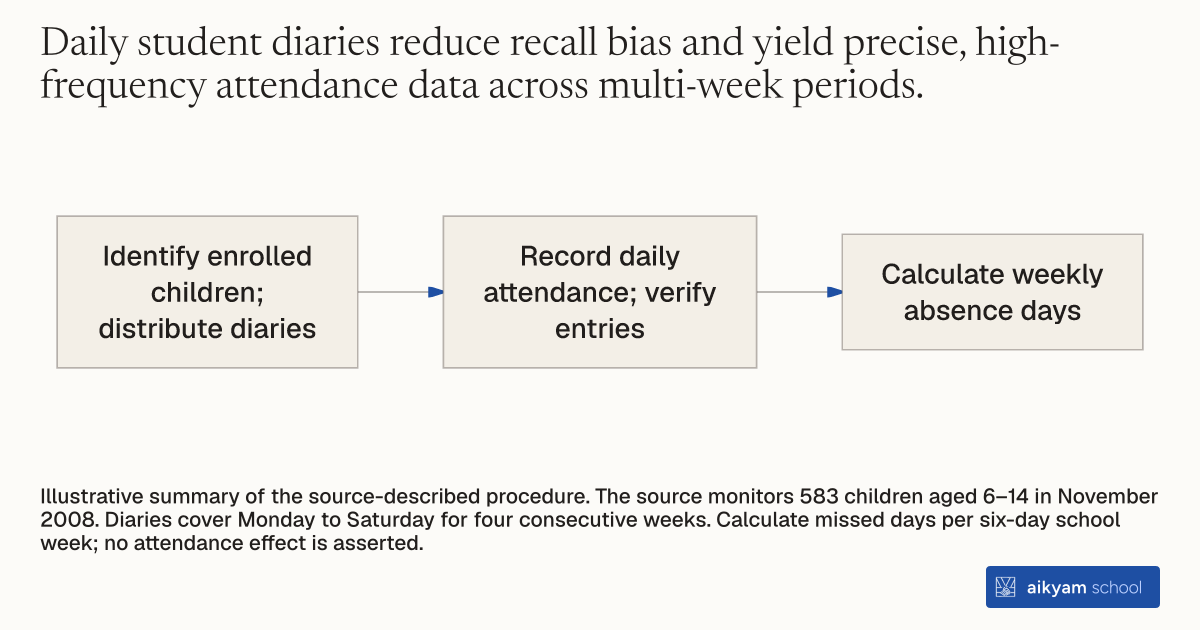
- Identify enrolled children; distribute diaries
- Record daily attendance; verify entries
- Calculate weekly absence days
Illustrative summary of the source-described procedure. The source monitors 583 children aged 6–14 in November 2008. Diaries cover Monday to Saturday for four consecutive weeks. Calculate missed days per six-day school week; no attendance effect is asserted.
See source →How
When to use
In infrastructure evaluations, long recall periods make it difficult to detect subtle changes in child school attendance caused by reduced household chores. This method tracks student school attendance through structured daily diaries maintained by households over a one-month period. It provides fine-grained attendance data to measure whether time saved from household chores improves schooling participation.
Track child school absenteeism using structured daily attendance diaries filled out by households over a one-month monitoring window.
- Identify all enrolled children aged 6 to 14 across study households during baseline surveys.
- Distribute visual school attendance diaries at the beginning of the school tracking month in November 2008.
- Instruct primary caretakers or students to record daily school attendance or absence for each school day from Monday through Saturday over four consecutive weeks.
- Surveyors conduct periodic home visits to collect, review, and verify the diary entries.
- Calculate weekly days of non-attendance per enrolled child across six-day school weeks.
Why it works
High-frequency tracking isolates school absenteeism from broader dropout trends and detects minor variations in attendance linked to household water collection duties.
Example
In Tangiers, Morocco, researchers monitored 583 enrolled children aged 6 to 14 across treatment and control households using a one-month daily school diary in November 2008. Analysis of the diaries showed an average control group absenteeism of 1.87 days per six-day week, and revealed that gaining a household water connection had no significant effect on reducing school absenteeism.
About the study
Participants
583 enrolled children aged 6 to 14 across treatment and control households in Tangiers, Morocco.
Study Design
One-month daily school attendance diary panel administered at endline in November 2008, measuring non-attendance across six-day school weeks from Monday through Saturday.
Results
Piped water connections produced no significant change in child school absenteeism, yielding an average treatment effect of 0.00 days (IV estimate 0.04 days) relative to a control group mean of 1.87 days of missed school per week.