Research design
Compare scorecards with and without peer lists
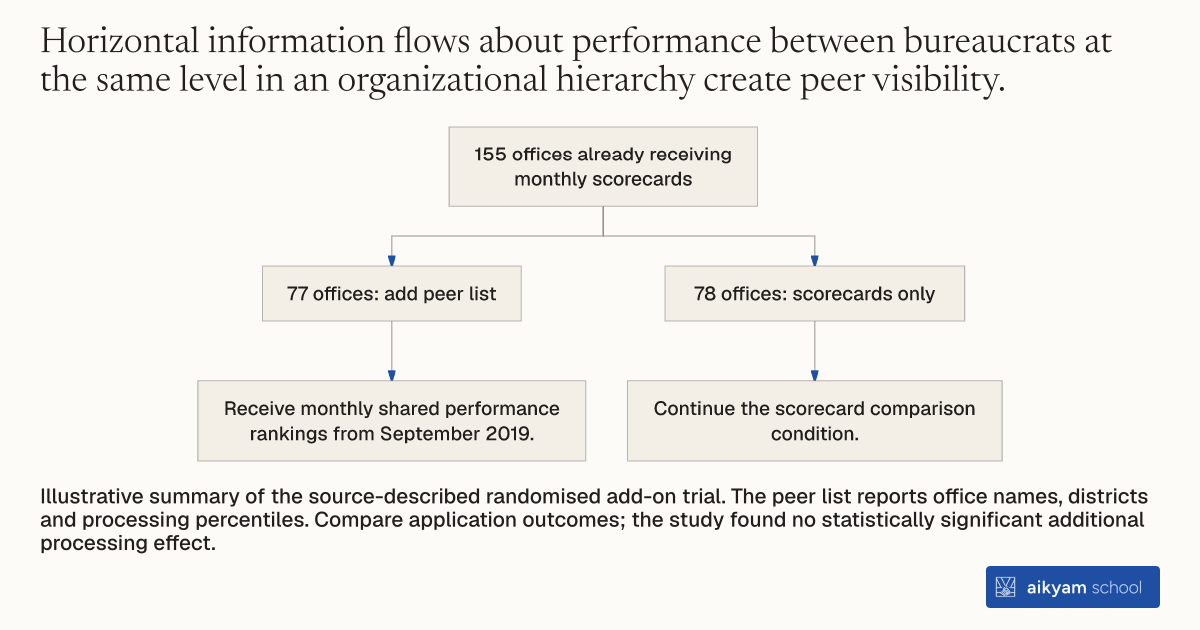
155 offices already receiving monthly scorecards
- 77 offices: add peer list
- Receive monthly shared performance rankings from September 2019.
- 78 offices: scorecards only
- Continue the scorecard comparison condition.
Illustrative summary of the source-described randomised add-on trial. The peer list reports office names, districts and processing percentiles. Compare application outcomes; the study found no statistically significant additional processing effect.
See source →How
When to use
Public administrative monitoring systems often provide performance feedback only privately between individual bureaucrats and their direct superiors, missing horizontal peer visibility. Public sector managers want to test whether sharing individual agency rankings directly among peer officials creates peer pressure or comparative performance competition. This method provides transparent multi-office performance ranking lists to civil service officers and regional supervisors.
Distribute a monthly comparative performance list containing percentile rankings for all participating subdistrict offices directly to every bureaucrat and supervisor in the network.
- Extract monthly application processing metrics for all subdistrict land offices from the central e-governance database.
- Compile a structured table displaying each subdistrict land office name, district name, disposed application percentile ranking, and pending application percentile ranking.
- Include explicit text informing recipients that the document displays performance ranks across all participating subdistricts and has been delivered to all peer offices.
- Print the compiled document titled "List of eMutation Performance" detailing performance indicators and improvement instructions.
- Dispatch physical printed lists monthly via courier to Assistant Commissioners Land, Upazila Nirbahi Officers, and Deputy Commissioners in every participating subdistrict.
Why it works
Explicitly showing officials where they stand relative to peers leverages social comparison, reputational standing, and peer monitoring to motivate performance.
Example
In Bangladesh, a monthly peer performance list displaying the percentile rankings of 77 subdistrict land offices was distributed to Assistant Commissioners Land, Upazila Nirbahi Officers, and Deputy Commissioners across all 77 offices starting in September 2019.
About the study
Participants
155 subdistrict land offices in Bangladesh receiving performance scorecards (77 randomly assigned to receive the peer list, 78 control).
Study Design
Sub-randomized controlled trial adding a shared peer performance list to 77 scorecard treatment offices starting in September 2019, evaluating application processing speeds from August 2019 to January 2020.
Results
Adding the peer performance list had no statistically significant additional effect on processing applications within 45 working days (0.8 percentage points) or log processing times (-0.060 log points).