Research procedure
Randomise newspaper comparisons
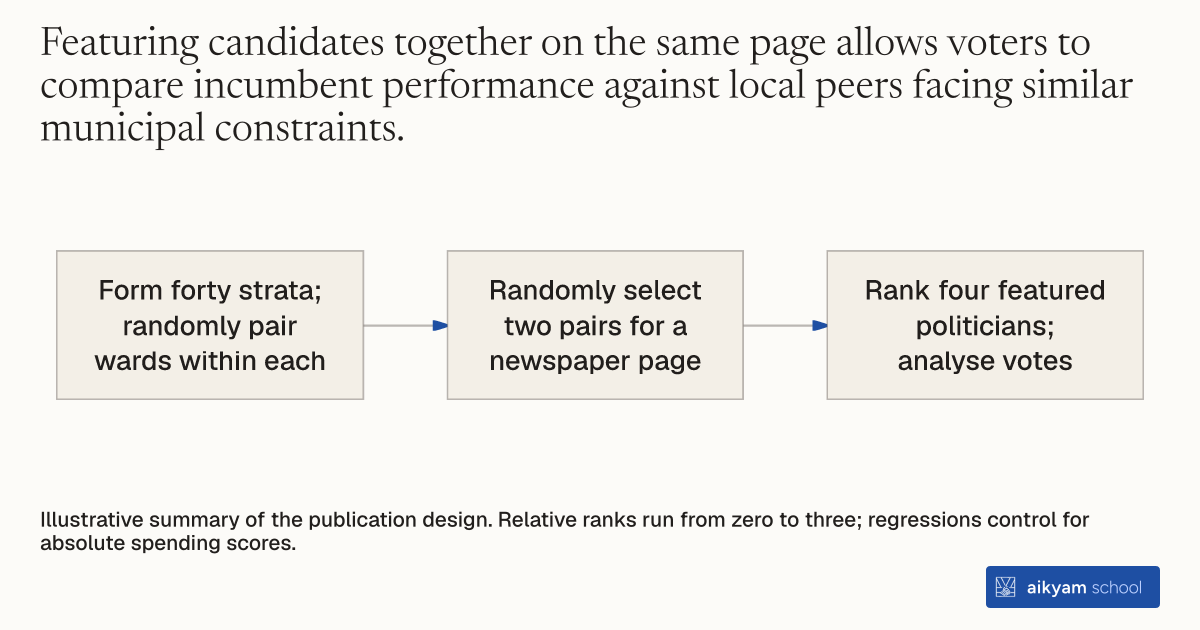
- Form forty strata; randomly pair wards within each
- Randomly select two pairs for a newspaper page
- Rank four featured politicians; analyse votes
Illustrative summary of the publication design. Relative ranks run from zero to three; regressions control for absolute spending scores.
See source →How
When to use
Evaluating the electoral impact of public performance disclosures is often confounded by unobserved politician characteristics. When voters observe an individual politician's performance record in isolation, researchers cannot easily separate absolute performance from relative peer comparisons. Randomly pairing politicians across daily newspaper editions creates exogenous variation in relative candidate rankings to estimate yardstick competition effects.
Randomly assign politicians to featured newspaper publication groups to create exogenous relative performance ranks.
- Categorize target electoral wards into forty comparable groups based on geographic zone, incumbent re-election eligibility, and slum area density.
- Pair wards randomly within each of the forty strata.
- Select two pairs randomly to feature on the same newspaper page in a daily edition.
- Calculate each politician's relative performance rank from zero to three among the four featured report cards in that daily edition.
- Estimate electoral regressions controlling for absolute spending scores to isolate the effect of relative rank.
Why it works
Randomizing candidate combinations ensures that relative rank variation is independent of absolute performance, isolating the impact of peer comparison on voter behavior.
Example
In Delhi, India, researchers assigned 124 municipal councilors with published report cards into four-person daily newspaper editions in Dainik Hindustan before the 2012 elections. A one-rank worsening in relative pro-poor spending among the four featured councilors decreased the incumbent party's vote share in that ward by 7 percentage points.
About the study
Participants
124 municipal wards with published report cards in Delhi, India.
Study Design
Pairwise randomization within forty zone-eligibility-slum strata, assigning pairs of wards to four-person daily newspaper editions to evaluate relative performance rank while controlling for absolute spending scores.
Results
A worsening of one rank in relative pro-poor spending among the four featured councilors in the same newspaper edition reduced the incumbent party's ward vote share by 7 percentage points (p = 0.02).