Research procedure
Track survey non-respondents
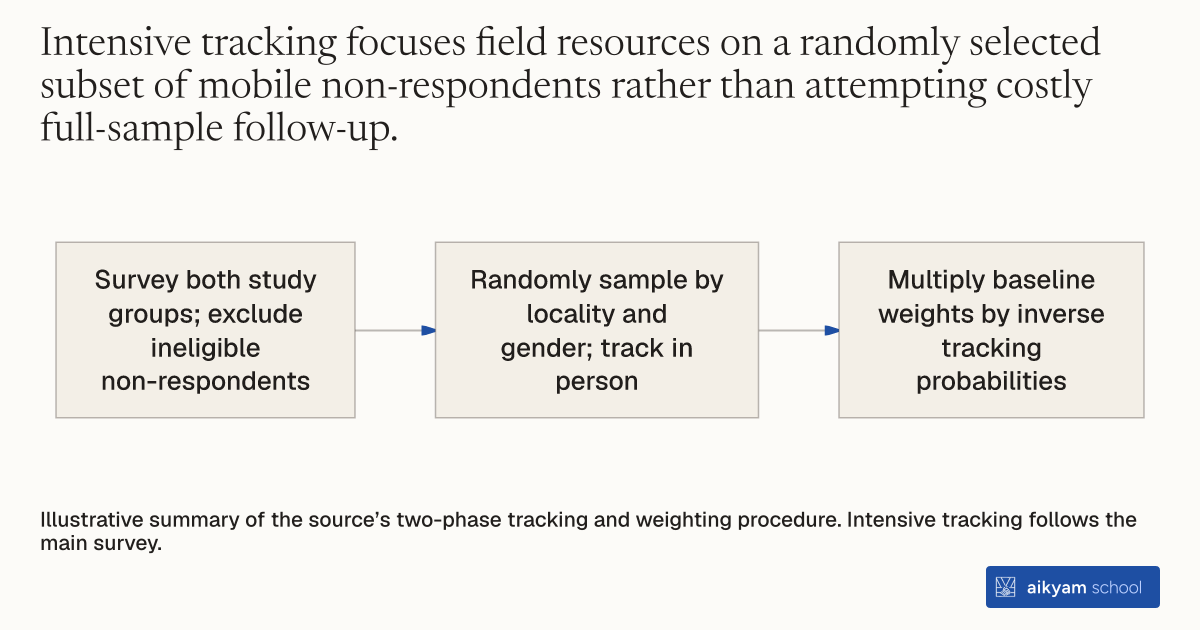
- Survey both study groups; exclude ineligible non-respondents
- Randomly sample by locality and gender; track in person
- Multiply baseline weights by inverse tracking probabilities
Illustrative summary of the source’s two-phase tracking and weighting procedure. Intensive tracking follows the main survey.
See source →How
When to use
Field surveys evaluating youth employment programs face high respondent mobility and attrition, especially among control group members who move for informal opportunities. Unmitigated attrition biases treatment effect estimates and degrades statistical power over multi-year evaluation cycles. A two-phase respondent tracking protocol locates initial non-respondents using targeted sampling and re-weighting to maintain balanced, representative survey samples.
Implement a two-phase survey tracking protocol to re-engage initial non-respondents and minimize attrition bias across study rounds.
- Conduct an initial main survey round across all eligible treatment and control sample members.
- Identify non-responding individuals from the primary survey pass and filter out ineligible cases such as deceased individuals or international emigrants.
- Randomly select a representative sub-sample of eligible non-respondents stratified by locality and gender for intensive tracking.
- Deploy specialized tracking teams to locate selected non-respondents in person using updated contact records and local community informants.
- Re-weight survey observations by multiplying baseline sampling weights by inverse tracking probabilities to restore sample representativeness.
Why it works
Applying inverse probability weighting to tracked respondents eliminates non-response bias while keeping total attrition low and balanced between study arms.
Example
During the midline survey in Côte d'Ivoire, research teams conducted a two-week tracking phase in February 2014 targeting non-respondents across 16 urban localities. This intensive tracking reduced the midline attrition rate from 5.4 percent down to 2.6 percent. A similar tracking phase in September 2015 maintained a final endline attrition rate of 6.2 percent across 4,160 study participants.
About the study
Participants
4,160 urban youth aged 18 to 30 years across 16 localities in Côte d'Ivoire followed across baseline, midline, and endline surveys.
Study Design
Randomized controlled trial employing a two-phase survey collection design in which main survey passes were followed by random sub-sampling of initial non-respondents for intensive field tracking and statistical inverse-probability re-weighting.
Results
At midline, the intensive tracking phase reduced overall survey attrition from 5.4 percent to 2.6 percent. At endline, the protocol maintained a final attrition rate of 6.2 percent that was statistically balanced between treatment and control groups.