Research steps
Household recontact
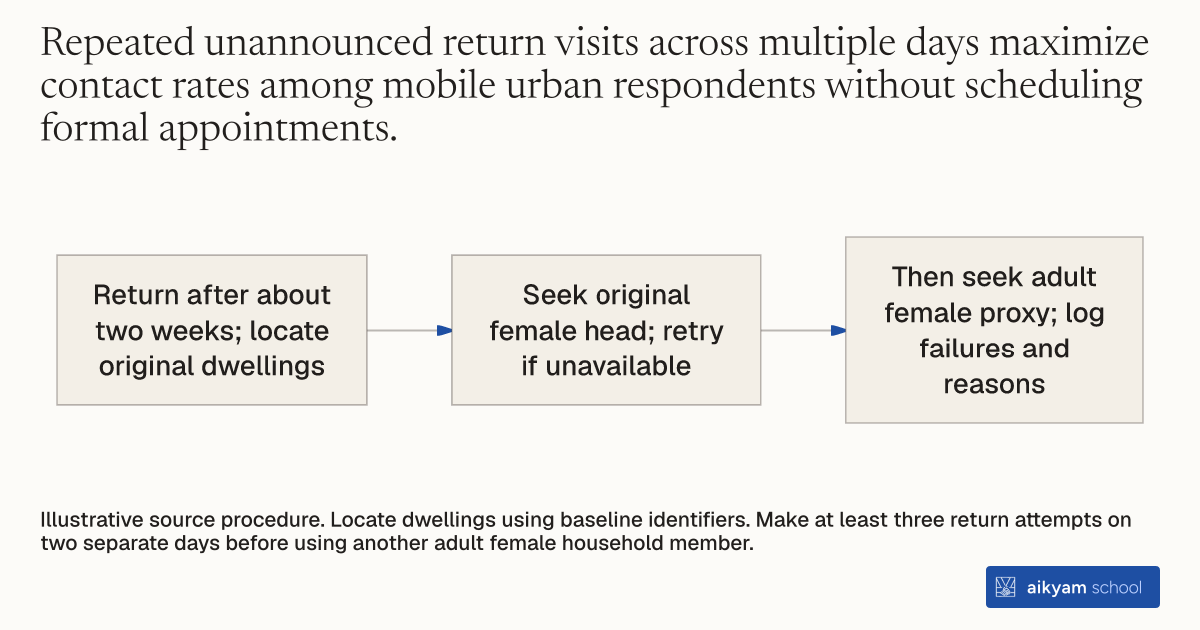
- Return after about two weeks; locate original dwellings
- Seek original female head; retry if unavailable
- Then seek adult female proxy; log failures and reasons
Illustrative source procedure. Locate dwellings using baseline identifiers. Make at least three return attempts on two separate days before using another adult female household member.
See source →How
When to use
Field experiments and longitudinal surveys in informal urban settlements often suffer from sample attrition over time due to household mobility. Failing to systematically track and reinterview original study participants introduces selection bias and degrades statistical power. This method provides an unannounced recontact protocol to follow up with field study participants across survey rounds.
Recontact study households in informal urban settlements using structured follow-up visits and attrition verification.
- Survey teams return to target residential compounds approximately two weeks after the marketing intervention.
- Surveyors locate original study dwellings using recorded baseline addresses and household identification numbers.
- If the dwelling is occupied, the surveyor asks to reinterview the original female head of household who completed the baseline survey.
- If no one is home or the primary respondent is temporarily unavailable, the surveyor makes at least three return attempts on two separate days.
- If the female head remains unavailable after repeated visits, the surveyor accepts another adult female household member as a secondary proxy respondent.
- If the household cannot be reached, the surveyor records a recontact failure and logs the specific reason.
Why it works
Verifying demographic identifiers against baseline data ensures that reinterviewed respondents match the original study participants.
Example
Surveyors sought to recontact 1,004 households reached during a marketing experiment in Lusaka, Zambia, successfully reinterviewing 890 households two weeks later. Among non-contacted households, 68 percent had either moved away or were temporarily away from home, with the remainder refusing interview.
About the study
Participants
1,004 households targeted for recontact across five low-income periurban compounds in Lusaka, Zambia.
Study Design
Two-week longitudinal recontact protocol employing up to three return attempts across multiple days, demographic verification checks, and formal logging of non-contact causes.
Results
Surveyors successfully reinterviewed 890 of 1,004 households, achieving an 88.6 percent recontact rate. Sixty-eight percent of non-contact cases were attributed to permanent or temporary relocation, with non-contact status statistically unrelated to experimental price assignments.