Research procedure
Follow applicants after office interviews
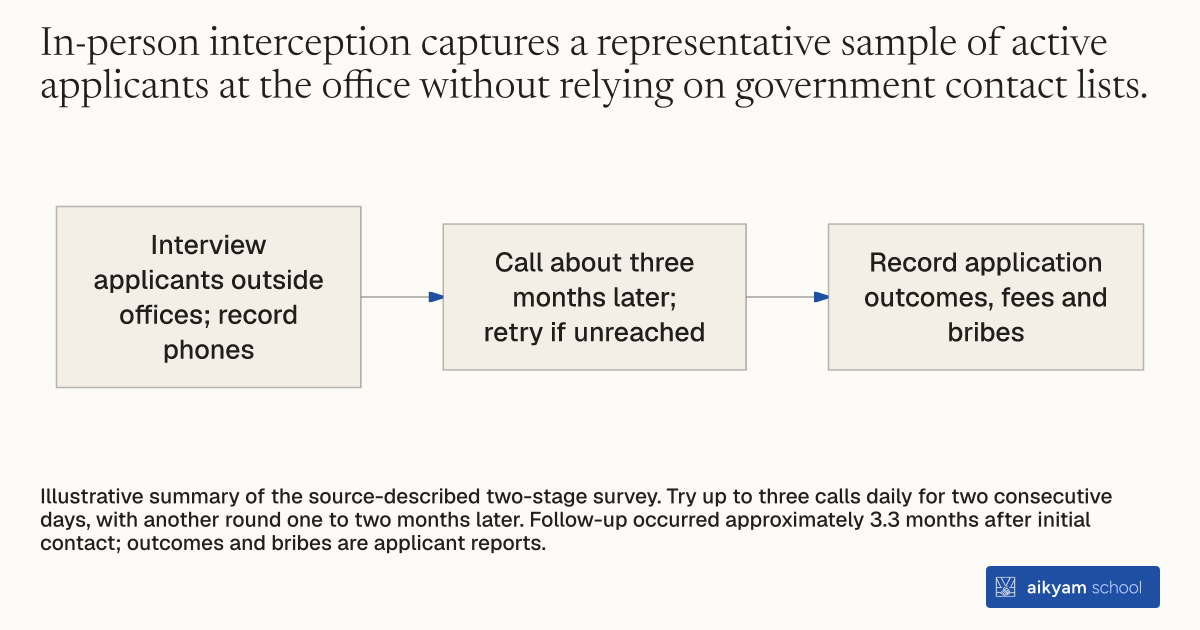
- Interview applicants outside offices; record phones
- Call about three months later; retry if unreached
- Record application outcomes, fees and bribes
Illustrative summary of the source-described two-stage survey. Try up to three calls daily for two consecutive days, with another round one to two months later. Follow-up occurred approximately 3.3 months after initial contact; outcomes and bribes are applicant reports.
See source →How
When to use
In government public service evaluations, gathering sensitive corruption and process performance data from citizens in person can suffer from applicant privacy concerns or incomplete application outcomes. Conducting follow-up interviews immediately at the office can miss post-processing bribe requests or delays. This method helps researchers collect baseline applicant data in person and measure ultimate application outcomes and bribe payments via phone calls after processing completes.
Conduct a two-stage survey combining in-person exit interviews at service offices with follow-up phone calls after service delivery completion.
- Station survey enumerators outside public offices to interview every citizen approaching the office for service delivery.
- Complete a short in-person interview gathering applicant background details, expected processing timelines, and phone numbers.
- Wait approximately three months for public officials to process the administrative application.
- Place follow-up phone calls to applicants up to three times per day over two consecutive days, making a second attempt round one to two months later if unreached.
- Record overall application outcomes, official fee payments, and bribe payments made to government officials or intermediaries.
Why it works
Phone follow-ups conducted months later allow applicants to report sensitive corruption experiences and final processing timelines after their case is fully resolved.
Example
In Bangladesh, enumerators conducted 3,213 in-person interviews outside 112 subdistrict land offices, followed by 2,869 completed phone interviews three months later that revealed average typical bribe payments of BDT 6,718.
About the study
Participants
3,213 land record change applicants interviewed in person outside 112 subdistrict land offices in Bangladesh, yielding 2,869 completed follow-up phone interviews (mean age 47, 6% female, average monthly household per capita expenditure BDT 4,396).
Study Design
Two-stage survey design with in-person intercept sampling outside public offices followed by structured phone interviews approximately 3.3 months later, analyzing reported bribes and application outcomes across treatment and control land offices.
Results
Achieved an 89% follow-up completion rate (2,869 out of 3,213 applicants), measuring an average typical bribe payment of BDT 6,718 (75% non-zero) and average reported bribe payment of BDT 1,477 (28% non-zero).