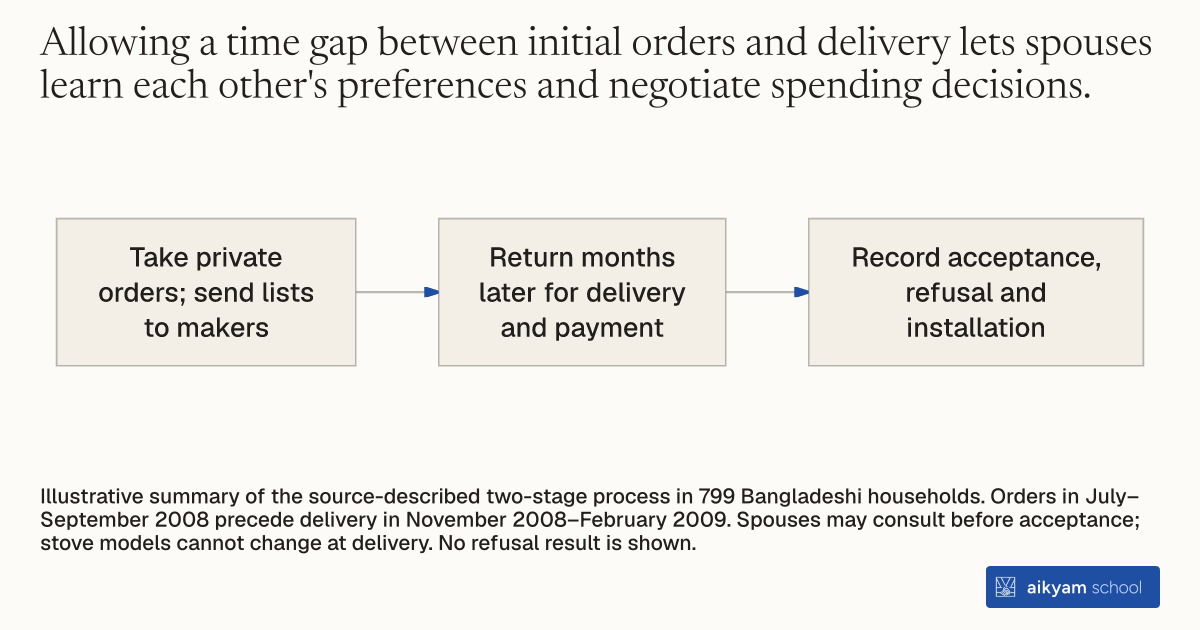
Research procedure
Compare private orders with final delivery
- Take private orders; send lists to makers
- Return months later for delivery and payment
- Record acceptance, refusal and installation
Illustrative summary of the source-described two-stage process in 799 Bangladeshi households. Orders in July–September 2008 precede delivery in November 2008–February 2009. Spouses may consult before acceptance; stove models cannot change at delivery. No refusal result is shown.
See source →How
When to use
Field interventions often record initial product interest without verifying if households keep and pay for the technology. Program managers need to measure how spousal consultation alters individual purchasing decisions over time. This method tracks adoption by separating initial private orders from final home delivery verification.
Separate technology ordering from physical delivery to measure intra-household decision revisions over time.
- Take initial product orders from individual spouses in isolation during marketing visits.
- Send order lists to local partner organization manufacturers to produce the requested items.
- Return to households several months later to deliver, collect payment, and install the ordered items.
- Allow households to accept or refuse the delivered product after spouses consult with each other.
- Prohibit households from changing stove model types during delivery to isolate initial preference choices.
- Record final installation and payment outcomes to calculate household refusal rates across demographic groups.
Why it works
Tracking refusals reveals when male financial heads overrule choices made by wives.
Example
Researchers implemented a two-stage ordering and delivery process with 799 households in 16 Bangladeshi villages between July 2008 and February 2009. Overall stove purchases dropped from an 84% initial order rate to a 49% final purchase rate. For subsidized stoves, households refused delivery 58% of the time, and wives who ordered stoves without male consent saw their choices overturned when husbands refused payment upon delivery.
About the study
Participants
799 rural households across 16 villages in Jamalpur and Hatia districts of Bangladesh.
Study Design
Two-stage randomized trial tracking individual private orders placed in July-September 2008 against final home delivery and payment acceptance between November 2008 and February 2009.
Results
Overall initial stove orders were 84%, but final purchases dropped to 49%. In subsidized arms, refusal rates reached 58% among those who ordered. In free stove arms, female initial order decisions faced higher refusal rates (30% overall non-purchase rate vs 31% for men), while subsidized female orders resulted in a 58% refusal rate upon delivery.