Research procedure
Separate trying from successful use
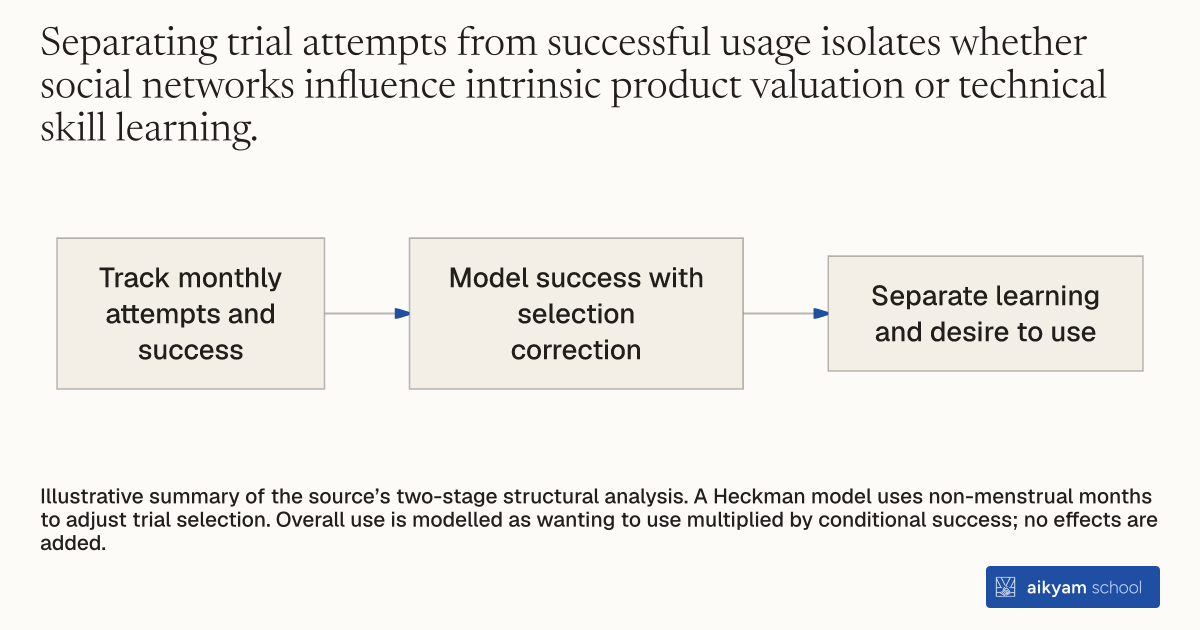
- Track monthly attempts and success
- Model success with selection correction
- Separate learning and desire to use
Illustrative summary of the source’s two-stage structural analysis. A Heckman model uses non-menstrual months to adjust trial selection. Overall use is modelled as wanting to use multiplied by conditional success; no effects are added.
See source →How
When to use
Organisations evaluate peer influence mechanisms for complex technologies among target users. Standard adoption estimates blend product valuation with practical usage learning, making it hard to identify why peer effects occur. A two-stage structural model separates desire to adopt from skill-based usage success.
Deconstruct technology adoption into separate stages of trial intent and usage success using a two-stage structural model.
- Collect monthly panel data tracking whether participants attempted usage and whether they succeeded.
- Estimate the effect of peer exposure on successful usage among participants who attempted trial.
- Correct for trial selection bias using a Heckman selection model indexed by non-menstrual months.
- Express overall usage probability as the product of wanting to use and conditional success probability.
- Decompose the derivative of total usage with respect to peer exposure into separate learning and valuation parameters.
- Calculate the structural effect of peer exposure on underlying desire to use while holding usage success constant.
Why it works
Adjusting trial decisions for expected success prevents mechanical usage learning from being misclassified as social imitation.
Example
Researchers modeled adoption data from 101 adolescent girls in Chitwan, Nepal over 15 months, finding peer exposure increased early usage success by 3 percentage points per friend-month while structural desire to use showed no significant change.
About the study
Participants
101 treatment adolescent girls across four schools in Chitwan District, Nepal observed over 15 months.
Study Design
Two-stage structural model and Heckman selection regressions estimating peer effects on monthly usage success conditional on trial and structural willingness to try.
Results
One additional friend-month of exposure increased successful usage probability by 3.06 percentage points in the first 5 months (p < 0.01), while structural desire to use increased by an insignificant 1.42 percentage points.