Try, learn and adjust
Check business cash and records stay separate
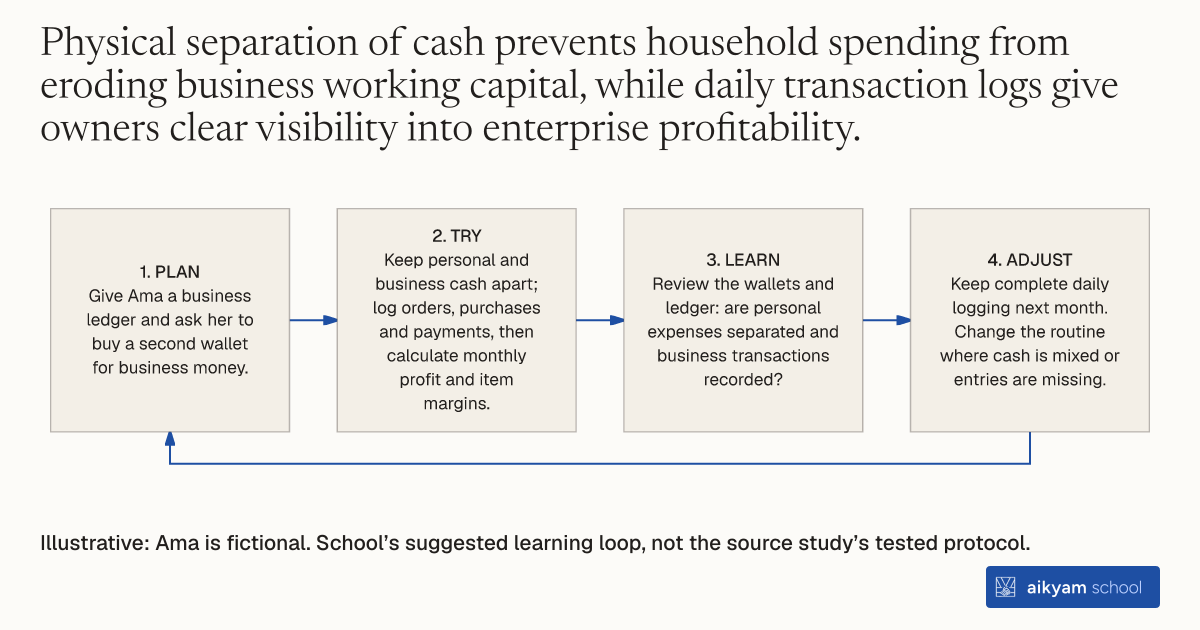
- Plan: Give Ama a business ledger and ask her to buy a second wallet for business money.
- Try: Keep personal and business cash apart; log orders, purchases and payments, then calculate monthly profit and item margins.
- Learn: Review the wallets and ledger: are personal expenses separated and business transactions recorded?
- Adjust: Keep complete daily logging next month. Change the routine where cash is mixed or entries are missing.
Illustrative: Ama is fictional. School’s suggested learning loop, not the source study’s tested protocol.
See source →School’s suggested, untested loop. Observe cash separation, entries and monthly calculations; early record-keeping gains did not remain statistically significant at 24 months.
How
When to use
Microenterprise owners frequently commingle personal and business cash, making it difficult to calculate net profit or maintain operational liquidity. Simple rules of thumb and basic paper ledgers establish clear financial boundaries without requiring complex accounting knowledge. This method serves small business owners who lack formal financial logging habits.
Implement physical cash separation and daily transaction logging routines in microenterprise shops.
- Provide the owner with a paper ledger logbook dedicated exclusively to business transactions.
- Instruct the owner to purchase a second wallet to hold business revenues separate from personal cash.
- Record every garment order, raw material purchase, and client payment immediately in the logbook.
- Pay personal living expenses strictly from the personal wallet and business costs from the second wallet.
- Sum daily revenues and expenses at the end of each month to calculate profit and loss statements.
- Calculate profit margins on individual garment items to determine which products drive shop earnings.
Example
Consultants taught tailors in Accra, Ghana, to separate personal and business cash using two wallets and to log transactions in paper ledgers. Record-keeping adoption increased by 45 percentage points at 6 months, but fell back to a 12 percentage point difference after 24 months as tailors abandoned the practice once consulting ended.
About the study
Participants
160 urban microenterprise tailors and seamstresses in Accra, Ghana.
Study Design
Randomized Controlled Trial evaluating rule-of-thumb financial instruction and ledger keeping across 8 survey waves over two years.
Results
Record keeping among consulting tailors increased by 45 percentage points at 6 months (Round 3, p < 0.01) and remained 26 percentage points higher at 12 months (Round 7, p < 0.05), but declined to a statistically insignificant 12 percentage point difference (with only 28% maintaining records) by 24 months (Round 8).