Try, learn and adjust
Check shop comfort and customer service
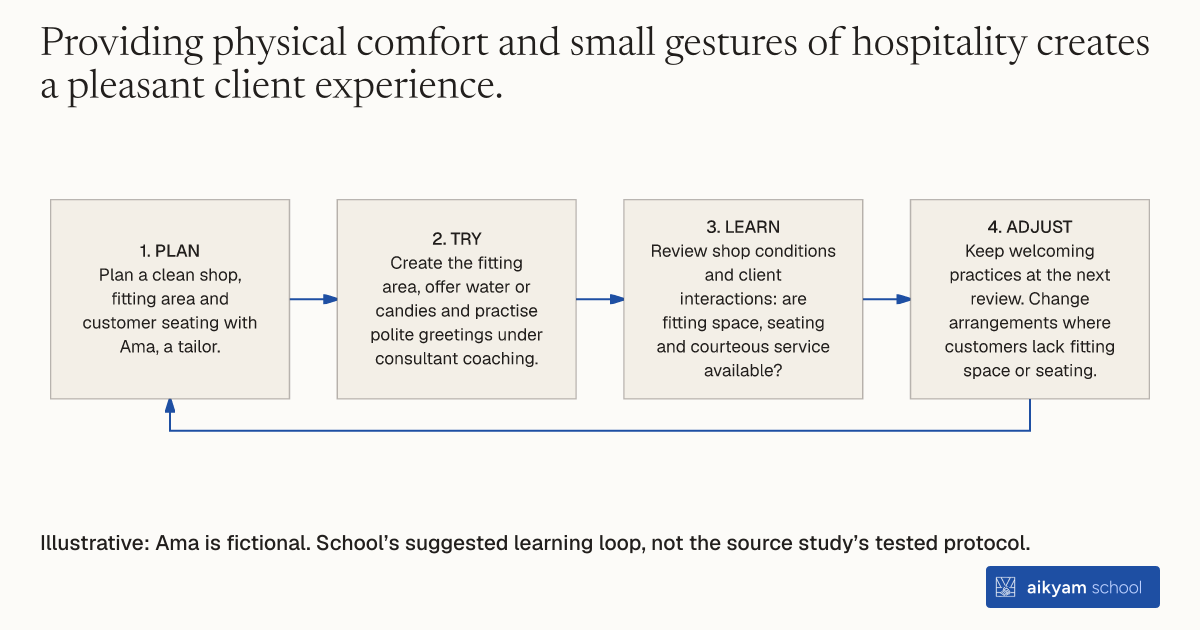
- Plan: Plan a clean shop, fitting area and customer seating with Ama, a tailor.
- Try: Create the fitting area, offer water or candies and practise polite greetings under consultant coaching.
- Learn: Review shop conditions and client interactions: are fitting space, seating and courteous service available?
- Adjust: Keep welcoming practices at the next review. Change arrangements where customers lack fitting space or seating.
Illustrative: Ama is fictional. School’s suggested learning loop, not the source study’s tested protocol.
See source →School’s suggested, untested loop. Observe amenities and customer interactions; do not attribute an individual’s profit change to these upgrades alone.
How
When to use
Small tailors often operate in informal, basic shops without dedicated fitting areas or client hospitality, causing potential buyers to feel uncomfortable or go elsewhere. Upgrading shop amenities and adopting polite customer service routines enhances client satisfaction and comfort. This method serves microenterprise owners looking to attract and retain retail buyers in competitive local markets.
Upgrade retail shop physical amenities and client hospitality practices to improve customer retention.
- Clean and organize the shop interior during monthly business operations to create a welcoming sales environment.
- Construct a dedicated dressing room or curtained fitting area inside the shop so clients can comfortably try on garments.
- Offer free hospitality items like purified water satchels or candies to every client visiting the shop.
- Practice polite verbal greetings and professional customer interactions during client visits under consultant coaching.
- Provide dedicated seating chairs inside the shop for clients waiting for garment fittings or orders.
Why it works
This helps microenterprises differentiate themselves from informal competitors and build customer loyalty.
Example
Under guidance from an Ernst & Young consultant, a 28-year-old seamstress named Sarah in Accra, Ghana, created a small dressing room area in her concrete shop and distributed purified water satchels and free candies to clients. Combined with record keeping and pre-made garment sales, Sarah raised her monthly profits from 90 cedis in December 2008 to 333 cedis in December 2010.
About the study
Participants
160 urban microenterprise tailors and seamstresses in Accra, Ghana.
Study Design
Randomized Controlled Trial evaluating management and customer service advisory modules across 8 survey waves over two years.
Results
Consultants provided feedback on client interactions during 30 to 60 minute shop visits; while individual high-talent tailors like Sarah increased monthly profits from 90 to 333 cedis, treatment tailors on average showed no statistically significant persistent income gains relative to controls across post-treatment rounds.